Motion Diagram Car Speeds Up Stops Then Speeds Up Again
xi Angular Momentum
11.1 Rolling Motion
Learning Objectives
Past the terminate of this section, you volition be able to:
- Describe the physics of rolling motion without slipping
- Explain how linear variables are related to angular variables for the case of rolling move without slipping
- Observe the linear and angular accelerations in rolling motion with and without slipping
- Summate the static friction forcefulness associated with rolling motion without slipping
- Use free energy conservation to analyze rolling motion
Rolling motion is that common combination of rotational and translational motion that we see everywhere, every day. Think about the different situations of wheels moving on a auto along a highway, or wheels on a plane landing on a runway, or wheels on a robotic explorer on another planet. Understanding the forces and torques involved in rolling motion is a crucial cistron in many different types of situations.
For analyzing rolling motion in this affiliate, refer to (Effigy) in Fixed-Centrality Rotation to detect moments of inertia of some common geometrical objects. You may likewise observe it useful in other calculations involving rotation.
Rolling Movement without Slipping
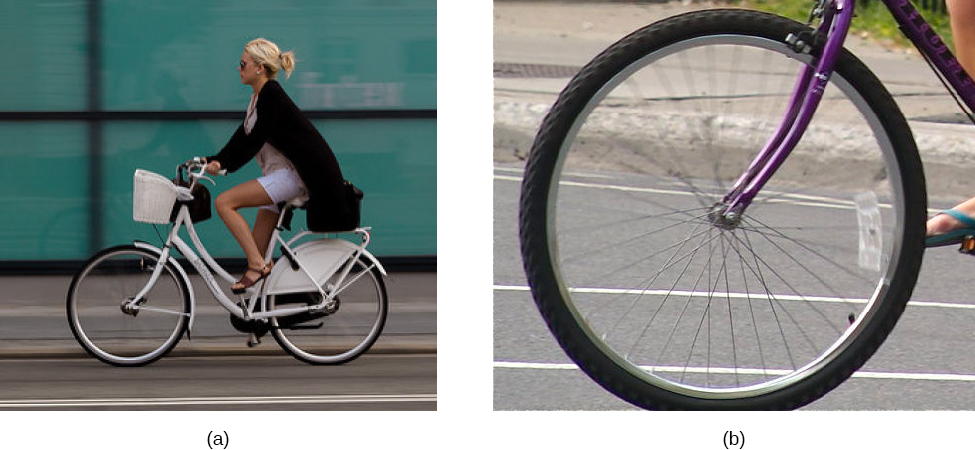
People have observed rolling motion without slipping ever since the invention of the wheel. For example, we tin can await at the interaction of a auto's tires and the surface of the route. If the driver depresses the accelerator to the flooring, such that the tires spin without the automobile moving forward, at that place must be kinetic friction between the wheels and the surface of the route. If the driver depresses the accelerator slowly, causing the car to move forrard, and then the tires roll without slipping. It is surprising to nearly people that, in fact, the bottom of the bike is at rest with respect to the ground, indicating there must be static friction between the tires and the road surface. In (Figure), the bicycle is in motion with the rider staying upright. The tires have contact with the road surface, and, even though they are rolling, the bottoms of the tires deform slightly, do not slip, and are at rest with respect to the road surface for a measurable amount of time. At that place must be static friction between the tire and the route surface for this to exist and so.
To analyze rolling without slipping, nosotros first derive the linear variables of velocity and dispatch of the center of mass of the bike in terms of the angular variables that depict the wheel's motion. The situation is shown in (Effigy).
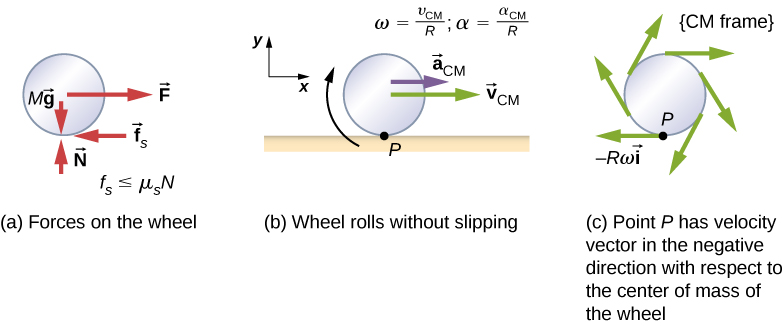
![\[\overset{\to }{F}\]](https://opentextbc.ca/universityphysicsv1openstax/wp-content/ql-cache/quicklatex.com-69fb8d059f69f2cce359780ca862e056_l3.png "Rendered by QuickLaTeX.com")
. The force of static friction
![\[{\overset{\to }{f}}_{\text{S}},|{\overset{\to }{f}}_{\text{S}}|\le {\mu }_{\text{S}}N\]](https://opentextbc.ca/universityphysicsv1openstax/wp-content/ql-cache/quicklatex.com-68ddff5e5b8462c61755a8d94ad04292_l3.png "Rendered by QuickLaTeX.com")
is large enough to go on information technology from slipping. (b) The linear velocity and acceleration vectors of the center of mass and the relevant expressions for
![\[\omega \,\text{and}\,\alpha\]](https://opentextbc.ca/universityphysicsv1openstax/wp-content/ql-cache/quicklatex.com-a68ae08df0b497150a8ffa3a11417878_l3.png "Rendered by QuickLaTeX.com")
. Indicate P is at rest relative to the surface. (c) Relative to the center of mass (CM) frame, point P has linear velocity
![\[\text{−}R\omega \hat{i}\]](https://opentextbc.ca/universityphysicsv1openstax/wp-content/ql-cache/quicklatex.com-30689fb593e5a868d7b45dd99e30d740_l3.png "Rendered by QuickLaTeX.com")
.
From (Figure)(a), we encounter the force vectors involved in preventing the cycle from slipping. In (b), bespeak P that touches the surface is at residue relative to the surface. Relative to the heart of mass, point P has velocity
, where R is the radius of the wheel and
![\[\omega\]](https://opentextbc.ca/universityphysicsv1openstax/wp-content/ql-cache/quicklatex.com-231d76a1dcdb84e30834c95bc7591fce_l3.png "Rendered by QuickLaTeX.com")
is the bicycle'southward angular velocity about its axis. Since the wheel is rolling, the velocity of P with respect to the surface is its velocity with respect to the center of mass plus the velocity of the center of mass with respect to the surface:
![\[{\overset{\to }{v}}_{P}=\text{−}R\omega \hat{i}+{v}_{\text{CM}}\hat{i}.\]](https://opentextbc.ca/universityphysicsv1openstax/wp-content/ql-cache/quicklatex.com-e1bd153d0ee3a6d8692b7e117fa902c0_l3.png "Rendered by QuickLaTeX.com")
Since the velocity of P relative to the surface is zero,
![\[{v}_{P}=0\]](https://opentextbc.ca/universityphysicsv1openstax/wp-content/ql-cache/quicklatex.com-71d7cd79589f91378979d44dfc54d59e_l3.png "Rendered by QuickLaTeX.com")
, this says that
![\[{v}_{\text{CM}}=R\omega .\]](https://opentextbc.ca/universityphysicsv1openstax/wp-content/ql-cache/quicklatex.com-5cb18f800af33cfc6149f80dc9a731e8_l3.png "Rendered by QuickLaTeX.com")
Thus, the velocity of the bicycle's center of mass is its radius times the angular velocity about its axis. We show the correspondence of the linear variable on the left side of the equation with the athwart variable on the right side of the equation. This is done below for the linear dispatch.
If we differentiate (Figure) on the left side of the equation, we obtain an expression for the linear acceleration of the center of mass. On the right side of the equation, R is a abiding and since
![\[\alpha =\frac{d\omega }{dt},\]](https://opentextbc.ca/universityphysicsv1openstax/wp-content/ql-cache/quicklatex.com-4a5430ac8b0b64d04b6fed9a49a40f31_l3.png "Rendered by QuickLaTeX.com")
we have
![\[{a}_{\text{CM}}=R\alpha .\]](https://opentextbc.ca/universityphysicsv1openstax/wp-content/ql-cache/quicklatex.com-0aa8a953287c465cec8c40fe298af765_l3.png "Rendered by QuickLaTeX.com")
Furthermore, we can find the distance the bicycle travels in terms of angular variables by referring to (Figure). As the wheel rolls from point A to point B, its outer surface maps onto the basis by exactly the distance travelled, which is
![\[{d}_{\text{CM}}.\]](https://opentextbc.ca/universityphysicsv1openstax/wp-content/ql-cache/quicklatex.com-804c663714d2a1cc0d3b7fd2d071404d_l3.png "Rendered by QuickLaTeX.com")
Nosotros see from (Figure) that the length of the outer surface that maps onto the footing is the arc length
![\[R\theta \text{}\]](https://opentextbc.ca/universityphysicsv1openstax/wp-content/ql-cache/quicklatex.com-f8a46d1570f2977257265fcae5fc3285_l3.png "Rendered by QuickLaTeX.com")
. Equating the two distances, we obtain
![\[{d}_{\text{CM}}=R\theta .\]](https://opentextbc.ca/universityphysicsv1openstax/wp-content/ql-cache/quicklatex.com-423b12de376b61ad770e021d082d9741_l3.png "Rendered by QuickLaTeX.com")
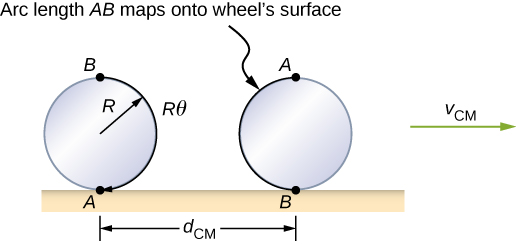
![\[R\theta\]](https://opentextbc.ca/universityphysicsv1openstax/wp-content/ql-cache/quicklatex.com-0451380e081363e6ca1d6ac592412a87_l3.png "Rendered by QuickLaTeX.com")
from A to B maps onto the surface, corresponding to the distance
![\[{d}_{\text{CM}}\]](https://opentextbc.ca/universityphysicsv1openstax/wp-content/ql-cache/quicklatex.com-b8c0550341e6af112cb9d6b8b525327e_l3.png "Rendered by QuickLaTeX.com")
that the heart of mass has moved.
Case
Rolling Down an Inclined Plane
A solid cylinder rolls down an inclined aeroplane without slipping, starting from remainder. It has mass m and radius r. (a) What is its acceleration? (b) What condition must the coefficient of static friction
![\[{\mu }_{\text{S}}\]](https://opentextbc.ca/universityphysicsv1openstax/wp-content/ql-cache/quicklatex.com-cf4aa428ce7fe45d7df306c0f73ff54f_l3.png "Rendered by QuickLaTeX.com")
satisfy so the cylinder does not slip?
Strategy
Draw a sketch and costless-body diagram, and cull a coordinate organisation. Nosotros put 10 in the management downward the airplane and y upward perpendicular to the aeroplane. Place the forces involved. These are the normal force, the force of gravity, and the force due to friction. Write downward Newton's laws in the x– and y-directions, and Newton's law for rotation, and then solve for the dispatch and strength due to friction.
Solution
- The free-body diagram and sketch are shown in (Figure), including the normal forcefulness, components of the weight, and the static friction forcefulness. In that location is barely enough friction to continue the cylinder rolling without slipping. Since there is no slipping, the magnitude of the friction force is less than or equal to
![\[{\mu }_{S}N\]](https://opentextbc.ca/universityphysicsv1openstax/wp-content/ql-cache/quicklatex.com-4cda714bde58272212e4ac9d17dce6c0_l3.png "Rendered by QuickLaTeX.com")
. Writing downwardly Newton's laws in the x– and y-directions, we have
![\[\sum {F}_{x}=m{a}_{x};\enspace\sum {F}_{y}=m{a}_{y}.\]](https://opentextbc.ca/universityphysicsv1openstax/wp-content/ql-cache/quicklatex.com-0f4c0da37dd2fa01473ab1ba450ebf29_l3.png "Rendered by QuickLaTeX.com")
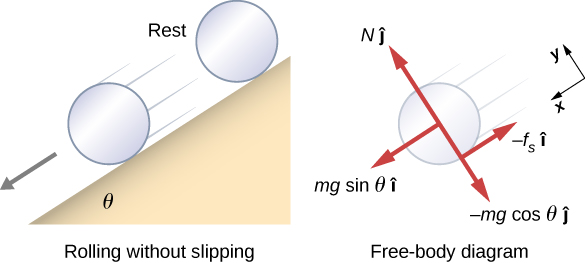
Effigy xi.five A solid cylinder rolls down an inclined plane without slipping from rest. The coordinate system has x in the direction downwardly the inclined airplane and y perpendicular to the plane. The free-body diagram is shown with the normal force, the static friction strength, and the components of the weight ![\[m\overset{\to }{g}\]](https://opentextbc.ca/universityphysicsv1openstax/wp-content/ql-cache/quicklatex.com-8926e83f5682dd478ff037eedb7b2222_l3.png "Rendered by QuickLaTeX.com")
. Friction makes the cylinder roll downwards the plane rather than skid.
Substituting in from the free-body diagram,
![\[\begin{array}{ccc}\hfill mg\,\text{sin}\,\theta -{f}_{\text{S}}& =\hfill & m{({a}_{\text{CM}})}_{x},\hfill \\ \hfill N-mg\,\text{cos}\,\theta & =\hfill & 0,\hfill \\ \hfill {f}_{\text{S}}& \le \hfill & {\mu }_{\text{S}}N,\hfill \end{array}\]](https://opentextbc.ca/universityphysicsv1openstax/wp-content/ql-cache/quicklatex.com-0a198d2759334e7151e6388d3632f764_l3.png "Rendered by QuickLaTeX.com")
we can then solve for the linear acceleration of the center of mass from these equations:
![\[{({a}_{\text{CM}})}_{x}=g(\text{sin}\,\theta -{\mu }_{S}\text{cos}\,\theta ).\]](https://opentextbc.ca/universityphysicsv1openstax/wp-content/ql-cache/quicklatex.com-9f9aff9343d86f5352ac4b4b8746e286_l3.png "Rendered by QuickLaTeX.com")
All the same, information technology is useful to express the linear acceleration in terms of the moment of inertia. For this, we write down Newton'southward second law for rotation,
![\[\sum {\tau }_{\text{CM}}={I}_{\text{CM}}\alpha .\]](https://opentextbc.ca/universityphysicsv1openstax/wp-content/ql-cache/quicklatex.com-8840028d35858863fd556531ad4b1967_l3.png "Rendered by QuickLaTeX.com")
The torques are calculated near the axis through the centre of mass of the cylinder. The only nonzero torque is provided by the friction forcefulness. We accept
![\[{f}_{\text{S}}r={I}_{\text{CM}}\alpha .\]](https://opentextbc.ca/universityphysicsv1openstax/wp-content/ql-cache/quicklatex.com-1dd2aa609d3552250f23af3dfe11f8a0_l3.png "Rendered by QuickLaTeX.com")
Finally, the linear acceleration is related to the angular acceleration by
![\[{({a}_{\text{CM}})}_{x}=r\alpha .\]](https://opentextbc.ca/universityphysicsv1openstax/wp-content/ql-cache/quicklatex.com-793deee4ef62b94bc6df90b16b9632d9_l3.png "Rendered by QuickLaTeX.com")
These equations can be used to solve for
![\[{a}_{\text{CM}},\alpha ,\,\text{and}\,{f}_{\text{S}}\]](https://opentextbc.ca/universityphysicsv1openstax/wp-content/ql-cache/quicklatex.com-28a824642a33db2e828a2c1a32114711_l3.png "Rendered by QuickLaTeX.com")
in terms of the moment of inertia, where nosotros have dropped the x-subscript. We write
![\[{a}_{\text{CM}}\]](https://opentextbc.ca/universityphysicsv1openstax/wp-content/ql-cache/quicklatex.com-299eba88dcfaff524bcb20be992953a8_l3.png "Rendered by QuickLaTeX.com")
in terms of the vertical component of gravity and the friction force, and make the following substitutions.
![\[{a}_{\text{CM}}=g\text{sin}\,\theta -\frac{{f}_{\text{S}}}{m}\]](https://opentextbc.ca/universityphysicsv1openstax/wp-content/ql-cache/quicklatex.com-660d5b293216c7f112a96c821bd428fd_l3.png "Rendered by QuickLaTeX.com")
![\[{f}_{\text{S}}=\frac{{I}_{\text{CM}}\alpha }{r}=\frac{{I}_{\text{CM}}{a}_{\text{CM}}}{{r}^{2}}\]](https://opentextbc.ca/universityphysicsv1openstax/wp-content/ql-cache/quicklatex.com-fdf32678930cf926922fa37a7c8bd897_l3.png "Rendered by QuickLaTeX.com")
From this we obtain
![\[\begin{array}{cc}\hfill {a}_{\text{CM}}& =g\,\text{sin}\,\theta -\frac{{I}_{\text{CM}}{a}_{\text{CM}}}{m{r}^{2}},\hfill \\ & =\frac{mg\,\text{sin}\,\theta }{m+({I}_{\text{CM}}\text{/}{r}^{2})}.\hfill \end{array}\]](https://opentextbc.ca/universityphysicsv1openstax/wp-content/ql-cache/quicklatex.com-809a3de8360e70d57f6b001011cfe1c6_l3.png "Rendered by QuickLaTeX.com")
Note that this event is independent of the coefficient of static friction,
.
Since we have a solid cylinder, from (Figure), we have
![\[{I}_{\text{CM}}=m{r}^{2}\text{/}2\]](https://opentextbc.ca/universityphysicsv1openstax/wp-content/ql-cache/quicklatex.com-8de980087e83b4fa25317141a919ee38_l3.png "Rendered by QuickLaTeX.com")
and
![\[{a}_{\text{CM}}=\frac{mg\,\text{sin}\,\theta }{m+(m{r}^{2}\text{/}2{r}^{2})}=\frac{2}{3}g\,\text{sin}\,\theta .\]](https://opentextbc.ca/universityphysicsv1openstax/wp-content/ql-cache/quicklatex.com-66bdc936f32fe3ba8ff3fdec6bcaf8bb_l3.png "Rendered by QuickLaTeX.com")
Therefore, nosotros have
![\[\alpha =\frac{{a}_{\text{CM}}}{r}=\frac{2}{3r}g\,\text{sin}\,\theta .\]](https://opentextbc.ca/universityphysicsv1openstax/wp-content/ql-cache/quicklatex.com-40bf041c71241c09577a9fab86bc5ba1_l3.png "Rendered by QuickLaTeX.com")
- Considering slipping does not occur,
![\[{f}_{\text{S}}\le {\mu }_{\text{S}}N\]](https://opentextbc.ca/universityphysicsv1openstax/wp-content/ql-cache/quicklatex.com-5bbb324c6fe4b552d568b68d1f912cf8_l3.png "Rendered by QuickLaTeX.com")
. Solving for the friction force,
![\[{f}_{\text{S}}={I}_{\text{CM}}\frac{\alpha }{r}={I}_{\text{CM}}\frac{({a}_{\text{CM}})}{{r}^{2}}=\frac{{I}_{\text{CM}}}{{r}^{2}}(\frac{mg\,\text{sin}\,\theta }{m+({I}_{\text{CM}}\text{/}{r}^{2})})=\frac{mg{I}_{\text{CM}}\,\text{sin}\,\theta }{m{r}^{2}+{I}_{\text{CM}}}.\]](https://opentextbc.ca/universityphysicsv1openstax/wp-content/ql-cache/quicklatex.com-d7bfc0b464cdefbae7e04f5c14593ce4_l3.png "Rendered by QuickLaTeX.com")
Substituting this expression into the condition for no slipping, and noting that
![\[N=mg\,\text{cos}\,\theta\]](https://opentextbc.ca/universityphysicsv1openstax/wp-content/ql-cache/quicklatex.com-3b4bd071cb904221991c9e8548c05408_l3.png "Rendered by QuickLaTeX.com")
, we take
![\[\frac{mg{I}_{\text{CM}}\text{sin}\,\theta }{m{r}^{2}+{I}_{\text{CM}}}\le {\mu }_{\text{S}}mg\,\text{cos}\,\theta\]](https://opentextbc.ca/universityphysicsv1openstax/wp-content/ql-cache/quicklatex.com-34a0105c48bf3329295b8a8e7b8b1f84_l3.png "Rendered by QuickLaTeX.com")
or
![\[{\mu }_{\text{S}}\ge \frac{\text{tan}\,\theta }{1+(m{r}^{2}\text{/}{I}_{\text{CM}})}.\]](https://opentextbc.ca/universityphysicsv1openstax/wp-content/ql-cache/quicklatex.com-9c6f5cf1130656b3c22b06924fd22eaa_l3.png "Rendered by QuickLaTeX.com")
For the solid cylinder, this becomes
![\[{\mu }_{\text{S}}\ge \frac{\text{tan}\,\theta }{1+(2m{r}^{2}\text{/}m{r}^{2})}=\frac{1}{3}\text{tan}\,\theta .\]](https://opentextbc.ca/universityphysicsv1openstax/wp-content/ql-cache/quicklatex.com-866e1ab603702950a9d9dfd76abb917a_l3.png "Rendered by QuickLaTeX.com")
Significance
- The linear acceleration is linearly proportional to
![\[\text{sin}\,\theta .\]](https://opentextbc.ca/universityphysicsv1openstax/wp-content/ql-cache/quicklatex.com-cf62c3b9b5969dfddc99bcfb4702685c_l3.png "Rendered by QuickLaTeX.com")
Thus, the greater the angle of the incline, the greater the linear dispatch, as would be expected. The angular acceleration, however, is linearly proportional to
![\[\text{sin}\,\theta\]](https://opentextbc.ca/universityphysicsv1openstax/wp-content/ql-cache/quicklatex.com-49dad9a7204c41e23382dc0f1190778d_l3.png "Rendered by QuickLaTeX.com")
and inversely proportional to the radius of the cylinder. Thus, the larger the radius, the smaller the angular acceleration.
- For no slipping to occur, the coefficient of static friction must be greater than or equal to
![\[(1\text{/}3)\text{tan}\,\theta\]](https://opentextbc.ca/universityphysicsv1openstax/wp-content/ql-cache/quicklatex.com-df30fc4975fc6848ff200fc82a91bd74_l3.png "Rendered by QuickLaTeX.com")
. Thus, the greater the angle of incline, the greater the coefficient of static friction must be to prevent the cylinder from slipping.
Check Your Agreement
A hollow cylinder is on an incline at an angle of
![\[60\text{°}.\]](https://opentextbc.ca/universityphysicsv1openstax/wp-content/ql-cache/quicklatex.com-162fa0a82ef8bd9438c06c94997fb132_l3.png "Rendered by QuickLaTeX.com")
The coefficient of static friction on the surface is
![\[{\mu }_{S}=0.6\]](https://opentextbc.ca/universityphysicsv1openstax/wp-content/ql-cache/quicklatex.com-56213203837db6809db11c185cf86aea_l3.png "Rendered by QuickLaTeX.com")
. (a) Does the cylinder roll without slipping? (b) Will a solid cylinder roll without slipping
[reveal-answer q="275472″]Show Answer[/reveal-respond]
[hidden-answer a="275472″]a.
![\[{\mu }_{\text{S}}\ge \frac{\text{tan}\,\theta }{1+(m{r}^{2}\text{/}{I}_{\text{CM}})}\]](https://opentextbc.ca/universityphysicsv1openstax/wp-content/ql-cache/quicklatex.com-55aa8aff0e75aed3b8a10bfd99f47e39_l3.png "Rendered by QuickLaTeX.com")
; inserting the angle and noting that for a hollow cylinder
![\[{I}_{\text{CM}}=m{r}^{2},\]](https://opentextbc.ca/universityphysicsv1openstax/wp-content/ql-cache/quicklatex.com-bec2d6a8c366f7d6224e43f13cda4099_l3.png "Rendered by QuickLaTeX.com")
we have
![\[{\mu }_{\text{S}}\ge \frac{\text{tan}\,60\text{°}}{1+(m{r}^{2}\text{/}m{r}^{2})}=\frac{1}{2}\text{tan}\,60\text{°}=0.87;\]](https://opentextbc.ca/universityphysicsv1openstax/wp-content/ql-cache/quicklatex.com-7f4eb1cf40853d5298f5017207ab217c_l3.png "Rendered by QuickLaTeX.com")
we are given a value of 0.6 for the coefficient of static friction, which is less than 0.87, then the status isn't satisfied and the hollow cylinder volition slip; b. The solid cylinder obeys the condition
![\[{\mu }_{\text{S}}\ge \frac{1}{3}\text{tan}\,\theta =\frac{1}{3}\text{tan}\,60\text{°}=0.58.\]](https://opentextbc.ca/universityphysicsv1openstax/wp-content/ql-cache/quicklatex.com-9593dbcd7aa7b3f53642ac7c81a3216e_l3.png "Rendered by QuickLaTeX.com")
The value of 0.6 for
satisfies this status, and so the solid cylinder volition non slip.[/hidden-answer]
It is worthwhile to repeat the equation derived in this case for the acceleration of an object rolling without slipping:
![\[{a}_{\text{CM}}=\frac{mg\,\text{sin}\,\theta }{m+({I}_{\text{CM}}\text{/}{r}^{2})}.\]](https://opentextbc.ca/universityphysicsv1openstax/wp-content/ql-cache/quicklatex.com-f4badaeb1b5e942e2bf0d206484392eb_l3.png "Rendered by QuickLaTeX.com")
This is a very useful equation for solving bug involving rolling without slipping. Note that the acceleration is less than that for an object sliding down a frictionless plane with no rotation. The dispatch volition besides be different for two rotating cylinders with different rotational inertias.
Rolling Motion with Slipping
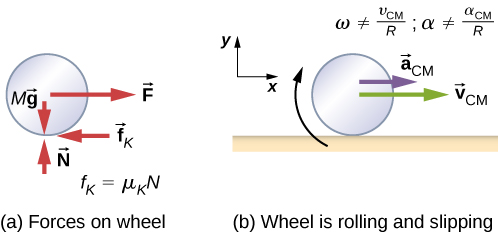
In the case of rolling motility with slipping, we must use the coefficient of kinetic friction, which gives rise to the kinetic friction forcefulness since static friction is not present. The situation is shown in (Figure). In the example of slipping,
![\[{v}_{\text{CM}}-R\omega \ne 0\]](https://opentextbc.ca/universityphysicsv1openstax/wp-content/ql-cache/quicklatex.com-819005938e53077dfc3eead69c92f1b1_l3.png "Rendered by QuickLaTeX.com")
, because point P on the bike is not at rest on the surface, and
![\[{v}_{P}\ne 0\]](https://opentextbc.ca/universityphysicsv1openstax/wp-content/ql-cache/quicklatex.com-1b512acafe6de084314a81007e6a6cf5_l3.png "Rendered by QuickLaTeX.com")
. Thus,
![\[\omega \ne \frac{{v}_{\text{CM}}}{R},\alpha \ne \frac{{a}_{\text{CM}}}{R}\]](https://opentextbc.ca/universityphysicsv1openstax/wp-content/ql-cache/quicklatex.com-b8731a43960ac5b2243e86d71461b8a4_l3.png "Rendered by QuickLaTeX.com")
.
Case
Rolling Downwards an Inclined Plane with Slipping
A solid cylinder rolls down an inclined airplane from rest and undergoes slipping ((Figure)). It has mass m and radius r. (a) What is its linear acceleration? (b) What is its angular acceleration about an axis through the heart of mass?
Strategy
Describe a sketch and free-trunk diagram showing the forces involved. The free-body diagram is similar to the no-slipping case except for the friction force, which is kinetic instead of static. Use Newton'southward second law to solve for the dispatch in the 10-direction. Utilise Newton's second police of rotation to solve for the angular acceleration.
Solution
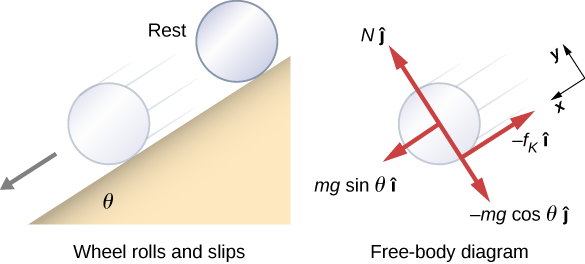
![\[m\overset{\to }{g}.\]](https://opentextbc.ca/universityphysicsv1openstax/wp-content/ql-cache/quicklatex.com-35b1b6d1b1f8525dc64a91b8cc2c8f0c_l3.png "Rendered by QuickLaTeX.com")
The sum of the forces in the y-direction is aught, and so the friction force is now
![\[{f}_{\text{k}}={\mu }_{\text{k}}N={\mu }_{\text{k}}mg\text{cos}\,\theta .\]](https://opentextbc.ca/universityphysicsv1openstax/wp-content/ql-cache/quicklatex.com-0f03705f664b00a9026423bce6a8c33b_l3.png "Rendered by QuickLaTeX.com")
Newton'southward second law in the x-direction becomes
![\[\sum {F}_{x}=m{a}_{x},\]](https://opentextbc.ca/universityphysicsv1openstax/wp-content/ql-cache/quicklatex.com-6ce99cf6e52b4172617e0a68c7ce1a44_l3.png "Rendered by QuickLaTeX.com")
![\[mg\,\text{sin}\,\theta -{\mu }_{\text{k}}mg\,\text{cos}\,\theta =m{({a}_{\text{CM}})}_{x},\]](https://opentextbc.ca/universityphysicsv1openstax/wp-content/ql-cache/quicklatex.com-62d001d8d059dd80674cc82338e8793b_l3.png "Rendered by QuickLaTeX.com")
or
![\[{({a}_{\text{CM}})}_{x}=g(\text{sin}\,\theta -{\mu }_{\text{K}}\,\text{cos}\,\theta ).\]](https://opentextbc.ca/universityphysicsv1openstax/wp-content/ql-cache/quicklatex.com-b8e4232c8ae8852edce35ece78fd6c22_l3.png "Rendered by QuickLaTeX.com")
The friction force provides the only torque about the axis through the center of mass, so Newton's second law of rotation becomes
![\[\sum {\tau }_{\text{CM}}={I}_{\text{CM}}\alpha ,\]](https://opentextbc.ca/universityphysicsv1openstax/wp-content/ql-cache/quicklatex.com-e6d2f2039650606d60f7974f3f0d7c87_l3.png "Rendered by QuickLaTeX.com")
![\[{f}_{\text{k}}r={I}_{\text{CM}}\alpha =\frac{1}{2}m{r}^{2}\alpha .\]](https://opentextbc.ca/universityphysicsv1openstax/wp-content/ql-cache/quicklatex.com-8d5e6c9e23b87d75d82839c3005de4fb_l3.png "Rendered by QuickLaTeX.com")
Solving for
![\[\alpha\]](https://opentextbc.ca/universityphysicsv1openstax/wp-content/ql-cache/quicklatex.com-e25e558ab99a96dadef19f4ac9a12710_l3.png "Rendered by QuickLaTeX.com")
, we take
![\[\alpha =\frac{2{f}_{\text{k}}}{mr}=\frac{2{\mu }_{\text{k}}g\,\text{cos}\,\theta }{r}.\]](https://opentextbc.ca/universityphysicsv1openstax/wp-content/ql-cache/quicklatex.com-bd73bc80ddc2b2e1f55ece919d831782_l3.png "Rendered by QuickLaTeX.com")
Significance
We write the linear and angular accelerations in terms of the coefficient of kinetic friction. The linear acceleration is the same as that found for an object sliding downwardly an inclined airplane with kinetic friction. The angular acceleration nigh the axis of rotation is linearly proportional to the normal force, which depends on the cosine of the angle of inclination. As
![\[\theta \to 90\text{°}\]](https://opentextbc.ca/universityphysicsv1openstax/wp-content/ql-cache/quicklatex.com-5ccc5208b4d5a167831ea19dad65df5e_l3.png "Rendered by QuickLaTeX.com")
, this force goes to zero, and, thus, the angular acceleration goes to zero.
Conservation of Mechanical Free energy in Rolling Motility
In the preceding chapter, nosotros introduced rotational kinetic free energy. Any rolling object carries rotational kinetic energy, as well as translational kinetic energy and potential energy if the organization requires. Including the gravitational potential free energy, the total mechanical free energy of an object rolling is
![\[{E}_{\text{T}}=\frac{1}{2}m{v}_{\text{CM}}^{2}+\frac{1}{2}{I}_{\text{CM}}{\omega }^{2}+mgh.\]](https://opentextbc.ca/universityphysicsv1openstax/wp-content/ql-cache/quicklatex.com-d15bf22f21212c0d9c1e8dafad348d67_l3.png "Rendered by QuickLaTeX.com")
In the absence of whatsoever nonconservative forces that would have free energy out of the system in the form of rut, the total free energy of a rolling object without slipping is conserved and is abiding throughout the motion. Examples where energy is non conserved are a rolling object that is slipping, product of heat as a result of kinetic friction, and a rolling object encountering air resistance.
You may inquire why a rolling object that is not slipping conserves energy, since the static friction force is nonconservative. The answer can be found by referring back to (Figure). Betoken P in contact with the surface is at rest with respect to the surface. Therefore, its minute displacement
![\[d\overset{\to }{r}\]](https://opentextbc.ca/universityphysicsv1openstax/wp-content/ql-cache/quicklatex.com-ab8299b410dd659f9149b1b3c6a2e970_l3.png "Rendered by QuickLaTeX.com")
with respect to the surface is zero, and the incremental piece of work done by the static friction forcefulness is zero. Nosotros can apply energy conservation to our study of rolling motion to bring out some interesting results.
Instance
Curiosity Rover
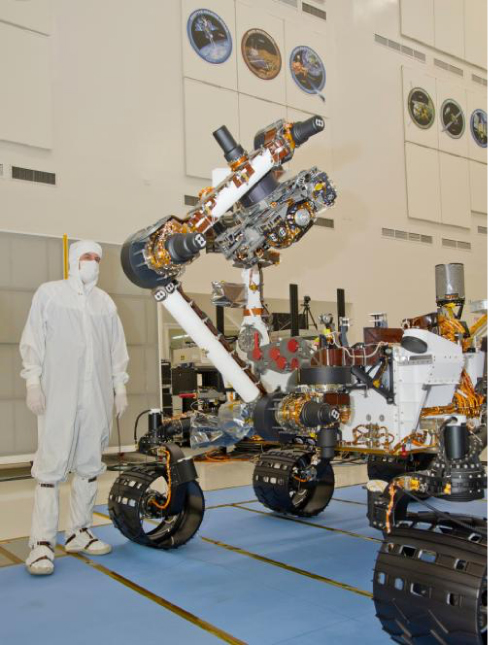
The Curiosity rover, shown in (Figure), was deployed on Mars on August vi, 2012. The wheels of the rover have a radius of 25 cm. Suppose astronauts make it on Mars in the yr 2050 and find the at present-inoperative Curiosity on the side of a bowl. While they are dismantling the rover, an astronaut accidentally loses a grip on ane of the wheels, which rolls without slipping downward into the bottom of the basin 25 meters below. If the wheel has a mass of 5 kg, what is its velocity at the bottom of the bowl?
Strategy
Nosotros apply mechanical energy conservation to analyze the problem. At the pinnacle of the hill, the wheel is at rest and has only potential energy. At the bottom of the basin, the wheel has rotational and translational kinetic energy, which must exist equal to the initial potential free energy by free energy conservation. Since the bike is rolling without slipping, we utilize the relation
![\[{v}_{\text{CM}}=r\omega\]](https://opentextbc.ca/universityphysicsv1openstax/wp-content/ql-cache/quicklatex.com-b90c4d41d9afb666f36d1523b5e900f4_l3.png "Rendered by QuickLaTeX.com")
to chronicle the translational variables to the rotational variables in the energy conservation equation. Nosotros then solve for the velocity. From (Figure), we see that a hollow cylinder is a good approximation for the wheel, so we tin can employ this moment of inertia to simplify the adding.
Solution
Energy at the pinnacle of the basin equals energy at the bottom:
![\[mgh=\frac{1}{2}m{v}_{\text{CM}}^{2}+\frac{1}{2}{I}_{\text{CM}}{\omega }^{2}.\]](https://opentextbc.ca/universityphysicsv1openstax/wp-content/ql-cache/quicklatex.com-92ef7a2a16cd02014c07daa157c5c803_l3.png "Rendered by QuickLaTeX.com")
The known quantities are
![\[{I}_{\text{CM}}=m{r}^{2}\text{,}\,r=0.25\,\text{m,}\,\text{and}\,h=25.0\,\text{m}\]](https://opentextbc.ca/universityphysicsv1openstax/wp-content/ql-cache/quicklatex.com-6c2085f8badebc3e0aa9b4d457044a14_l3.png "Rendered by QuickLaTeX.com")
.
We rewrite the energy conservation equation eliminating
by using
![\[\omega =\frac{{v}_{\text{CM}}}{r}.\]](https://opentextbc.ca/universityphysicsv1openstax/wp-content/ql-cache/quicklatex.com-8ad963e27546aaad65bb3a43dd8e4950_l3.png "Rendered by QuickLaTeX.com")
We have
![\[mgh=\frac{1}{2}m{v}_{\text{CM}}^{2}+\frac{1}{2}m{r}^{2}\frac{{v}_{\text{CM}}^{2}}{{r}^{2}}\]](https://opentextbc.ca/universityphysicsv1openstax/wp-content/ql-cache/quicklatex.com-a045bdc3062b4f52fef904e07cca8ee6_l3.png "Rendered by QuickLaTeX.com")
or
![\[gh=\frac{1}{2}{v}_{\text{CM}}^{2}+\frac{1}{2}{v}_{\text{CM}}^{2}⇒{v}_{\text{CM}}=\sqrt{gh}.\]](https://opentextbc.ca/universityphysicsv1openstax/wp-content/ql-cache/quicklatex.com-35bca33a5d505bdc9fb804045f1a30c6_l3.png "Rendered by QuickLaTeX.com")
On Mars, the acceleration of gravity is
![\[3.71\,{\,\text{m/s}}^{2},\]](https://opentextbc.ca/universityphysicsv1openstax/wp-content/ql-cache/quicklatex.com-d151648585cd11ff5a77ee5ceab418a0_l3.png "Rendered by QuickLaTeX.com")
which gives the magnitude of the velocity at the bottom of the basin equally
![\[{v}_{\text{CM}}=\sqrt{(3.71\,\text{m}\text{/}{\text{s}}^{2})25.0\,\text{m}}=9.63\,\text{m}\text{/}\text{s}\text{.}\]](https://opentextbc.ca/universityphysicsv1openstax/wp-content/ql-cache/quicklatex.com-7a49097519e8bf4e5a315be82ad43c47_l3.png "Rendered by QuickLaTeX.com")
Significance
This is a fairly authentic result considering that Mars has very piddling temper, and the loss of energy due to air resistance would be minimal. The result besides assumes that the terrain is smooth, such that the wheel wouldn't encounter rocks and bumps forth the way.
Also, in this example, the kinetic energy, or free energy of motion, is equally shared between linear and rotational motion. If we look at the moments of inertia in (Effigy), nosotros see that the hollow cylinder has the largest moment of inertia for a given radius and mass. If the wheels of the rover were solid and approximated past solid cylinders, for example, there would be more kinetic free energy in linear motion than in rotational motion. This would requite the wheel a larger linear velocity than the hollow cylinder approximation. Thus, the solid cylinder would attain the bottom of the basin faster than the hollow cylinder.
Summary
- In rolling motion without slipping, a static friction force is present betwixt the rolling object and the surface. The relations
![\[{v}_{\text{CM}}=R\omega ,{a}_{\text{CM}}=R\alpha ,\,\text{and}\,{d}_{\text{CM}}=R\theta\]](https://opentextbc.ca/universityphysicsv1openstax/wp-content/ql-cache/quicklatex.com-37539ca716dc25ca4b600911b152bb1b_l3.png "Rendered by QuickLaTeX.com")
all utilise, such that the linear velocity, acceleration, and distance of the center of mass are the angular variables multiplied past the radius of the object.
- In rolling motion with slipping, a kinetic friction forcefulness arises between the rolling object and the surface. In this case,
![\[{v}_{\text{CM}}\ne R\omega ,{a}_{\text{CM}}\ne R\alpha ,\,\text{and}\,{d}_{\text{CM}}\ne R\theta\]](https://opentextbc.ca/universityphysicsv1openstax/wp-content/ql-cache/quicklatex.com-a9fc61c7301bbe8bebdaef3b8b6809ef_l3.png "Rendered by QuickLaTeX.com")
.
- Free energy conservation can be used to clarify rolling motility. Energy is conserved in rolling move without slipping. Energy is not conserved in rolling motion with slipping due to the estrus generated by kinetic friction.
Conceptual Questions
Can a round object released from rest at the superlative of a frictionless incline undergo rolling motion?
[reveal-respond q="fs-id1165036812159″]Show Solution[/reveal-reply]
[hidden-answer a="fs-id1165036812159″]
No, the static friction forcefulness is nix.
[/hidden-answer]
A cylindrical can of radius R is rolling beyond a horizontal surface without slipping. (a) Afterward one complete revolution of the can, what is the distance that its center of mass has moved? (b) Would this altitude be greater or smaller if slipping occurred?
A bicycle is released from the top on an incline. Is the wheel virtually likely to slip if the incline is steep or gently sloped?
[reveal-reply q="fs-id1165037047596″]Show Solution[/reveal-respond]
[subconscious-respond a="fs-id1165037047596″]
The wheel is more likely to slip on a steep incline since the coefficient of static friction must increase with the angle to keep rolling motility without slipping.
[/hidden-answer]
Which rolls down an inclined plane faster, a hollow cylinder or a solid sphere? Both have the same mass and radius.
A hollow sphere and a hollow cylinder of the same radius and mass roll upwards an incline without slipping and have the same initial center of mass velocity. Which object reaches a greater tiptop earlier stopping?
[reveal-answer q="fs-id1165036990641″]Bear witness Solution[/reveal-answer]
[hidden-reply a="fs-id1165036990641″]
The cylinder reaches a greater height. By (Figure), its acceleration in the direction down the incline would be less.
[/subconscious-answer]
Problems
What is the angular velocity of a 75.0-cm-bore tire on an automobile traveling at 90.0 km/h?
[reveal-answer q="719142″]Show Answer[/reveal-reply]
[hidden-answer a="719142″]
![\[{v}_{\text{CM}}=R\omega \,⇒\omega =66.7\,\text{rad/s}\]](https://opentextbc.ca/universityphysicsv1openstax/wp-content/ql-cache/quicklatex.com-e88260e237d887c10855371700ec6a5c_l3.png "Rendered by QuickLaTeX.com")
[/hidden-answer]
A boy rides his bicycle 2.00 km. The wheels have radius thirty.0 cm. What is the total angle the tires rotate through during his trip?
If the male child on the cycle in the preceding trouble accelerates from rest to a speed of 10.0 grand/s in ten.0 s, what is the angular dispatch of the tires?
[reveal-answer q="fs-id1165037846364″]Bear witness Solution[/reveal-respond]
[hidden-reply a="fs-id1165037846364″]
![\[\alpha =3.3\,\text{rad}\text{/}{\text{s}}^{2}\]](https://opentextbc.ca/universityphysicsv1openstax/wp-content/ql-cache/quicklatex.com-e735818f039c6c8b7acb55072d07d47b_l3.png "Rendered by QuickLaTeX.com")
[/hidden-answer]
Formula Ane race cars take 66-cm-diameter tires. If a Formula Ane averages a speed of 300 km/h during a race, what is the angular displacement in revolutions of the wheels if the race machine maintains this speed for 1.5 hours?
A marble rolls down an incline at
![\[30\text{°}\]](https://opentextbc.ca/universityphysicsv1openstax/wp-content/ql-cache/quicklatex.com-c94934d8a2dddef67c8b7502e575de0e_l3.png "Rendered by QuickLaTeX.com")
from rest. (a) What is its acceleration? (b) How far does it get in 3.0 south?
[reveal-answer q="fs-id1165038000616″]Show Solution[/reveal-respond]
[hidden-answer a="fs-id1165038000616″]
![\[{I}_{\text{CM}}=\frac{2}{5}m{r}^{2},\,{a}_{\text{CM}}=3.5\,\text{m}\text{/}{\text{s}}^{2};\,x=15.75\,\text{m}\]](https://opentextbc.ca/universityphysicsv1openstax/wp-content/ql-cache/quicklatex.com-ef95d2d0f7451c941e3ac7a4bfccded2_l3.png "Rendered by QuickLaTeX.com")
[/hidden-answer]
Echo the preceding problem replacing the marble with a solid cylinder. Explain the new result.
A rigid body with a cylindrical cross-department is released from the top of a
incline. It rolls ten.0 g to the bottom in 2.threescore southward. Detect the moment of inertia of the torso in terms of its mass thou and radius r.
[reveal-reply q="fs-id1165037169593″]Show Solution[/reveal-answer]
[hidden-answer a="fs-id1165037169593″]
positive is downwards the incline plane;
![\[{a}_{\text{CM}}=\frac{mg\,\text{sin}\,\theta }{m+({I}_{\text{CM}}\text{/}{r}^{2})}⇒{I}_{\text{CM}}={r}^{2}[\frac{mg\,\text{sin}30}{{a}_{\text{CM}}}-m]\]](https://opentextbc.ca/universityphysicsv1openstax/wp-content/ql-cache/quicklatex.com-98cf87ba3d6b16658a395c06870eb9fd_l3.png "Rendered by QuickLaTeX.com")
,
![\[x-{x}_{0}={v}_{0}t-\frac{1}{2}{a}_{\text{CM}}{t}^{2}⇒{a}_{\text{CM}}=2.96\,{\text{m/s}}^{2},\]](https://opentextbc.ca/universityphysicsv1openstax/wp-content/ql-cache/quicklatex.com-371d33250f2623ccf403aeff3b37dba0_l3.png "Rendered by QuickLaTeX.com")
![\[{I}_{\text{CM}}=0.66\,m{r}^{2}\]](https://opentextbc.ca/universityphysicsv1openstax/wp-content/ql-cache/quicklatex.com-9eb9d7af3009a42c3ea534b27ca7b563_l3.png "Rendered by QuickLaTeX.com")
[/hidden-answer]
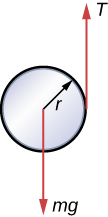
A yo-yo tin can be idea of a solid cylinder of mass m and radius r that has a light string wrapped effectually its circumference (encounter below). One end of the string is held fixed in infinite. If the cylinder falls as the string unwinds without slipping, what is the acceleration of the cylinder?
A solid cylinder of radius ten.0 cm rolls down an incline with slipping. The angle of the incline is
![\[30\text{°}.\]](https://opentextbc.ca/universityphysicsv1openstax/wp-content/ql-cache/quicklatex.com-a3e484fbcf5d6b45b6cbeb7207c585a9_l3.png "Rendered by QuickLaTeX.com")
The coefficient of kinetic friction on the surface is 0.400. What is the angular acceleration of the solid cylinder? What is the linear acceleration?
[reveal-answer q="fs-id1165038304382″]Show Solution[/reveal-answer]
[hidden-answer a="fs-id1165038304382″]
![\[\alpha =67.9\,\text{rad}\text{/}{\text{s}}^{2}\]](https://opentextbc.ca/universityphysicsv1openstax/wp-content/ql-cache/quicklatex.com-61b2a1e42bc9bfb85e3e086883c45675_l3.png "Rendered by QuickLaTeX.com")
,
![\[{({a}_{\text{CM}})}_{x}=1.5\,\text{m}\text{/}{\text{s}}^{2}\]](https://opentextbc.ca/universityphysicsv1openstax/wp-content/ql-cache/quicklatex.com-f4e4b0cee858339e8ead12c0673907bf_l3.png "Rendered by QuickLaTeX.com")
[/hidden-answer]
A bowling ball rolls upward a ramp 0.5 m high without slipping to storage. It has an initial velocity of its center of mass of three.0 m/s. (a) What is its velocity at the top of the ramp? (b) If the ramp is i m high does it go far to the pinnacle?
A 40.0-kg solid cylinder is rolling across a horizontal surface at a speed of 6.0 m/s. How much work is required to stop it?
[reveal-answer q="fs-id1165037047359″]Prove Solution[/reveal-answer]
[subconscious-answer a="fs-id1165037047359″]
![\[W=-1080.0\,\text{J}\]](https://opentextbc.ca/universityphysicsv1openstax/wp-content/ql-cache/quicklatex.com-9d91498005bee55d18dac4c09fb391f6_l3.png "Rendered by QuickLaTeX.com")
[/hidden-answer]
A twoscore.0-kg solid sphere is rolling across a horizontal surface with a speed of 6.0 m/south. How much work is required to stop it? Compare results with the preceding problem.
A solid cylinder rolls upward an incline at an bending of
![\[20\text{°}.\]](https://opentextbc.ca/universityphysicsv1openstax/wp-content/ql-cache/quicklatex.com-1e8da2110a831fa58a8da031c118c4c6_l3.png "Rendered by QuickLaTeX.com")
If it starts at the bottom with a speed of 10 one thousand/south, how far up the incline does it travel?
[reveal-answer q="fs-id1165038133403″]Show Solution[/reveal-answer]
[hidden-reply a="fs-id1165038133403″]
Mechanical energy at the lesser equals mechanical energy at the peak;
![\[\frac{1}{2}m{v}_{0}^{2}+\frac{1}{2}(\frac{1}{2}m{r}^{2}){(\frac{{v}_{0}}{r})}^{2}=mgh⇒h=\frac{1}{g}(\frac{1}{2}+\frac{1}{4}){v}_{0}^{2}\]](https://opentextbc.ca/universityphysicsv1openstax/wp-content/ql-cache/quicklatex.com-fcf4ad9b4cd2a5d89f111c3e92920c14_l3.png "Rendered by QuickLaTeX.com")
,
![\[h=7.7\,\text{m,}\]](https://opentextbc.ca/universityphysicsv1openstax/wp-content/ql-cache/quicklatex.com-ea86c63d835300a63a06d735abc8caf1_l3.png "Rendered by QuickLaTeX.com")
so the distance upwards the incline is
![\[22.5\,\text{m}\]](https://opentextbc.ca/universityphysicsv1openstax/wp-content/ql-cache/quicklatex.com-8d8a915d68a645eb402184e38abf25d0_l3.png "Rendered by QuickLaTeX.com")
.
[/hidden-answer]
A solid cylindrical wheel of mass M and radius R is pulled by a force
applied to the center of the wheel at
![\[37\text{°}\]](https://opentextbc.ca/universityphysicsv1openstax/wp-content/ql-cache/quicklatex.com-4f4dd609cde23dd8decbeb440bae0d2d_l3.png "Rendered by QuickLaTeX.com")
to the horizontal (see the post-obit figure). If the wheel is to roll without slipping, what is the maximum value of
![\[|\overset{\to }{F}|?\]](https://opentextbc.ca/universityphysicsv1openstax/wp-content/ql-cache/quicklatex.com-b5af9143c01fa7ab81fd71f4298f6630_l3.png "Rendered by QuickLaTeX.com")
The coefficients of static and kinetic friction are
![\[{\mu }_{\text{S}}=0.40\,\text{and}\,{\mu }_{\text{k}}=0.30.\]](https://opentextbc.ca/universityphysicsv1openstax/wp-content/ql-cache/quicklatex.com-48b9a0280ce8ea627c5d3ba974c65162_l3.png "Rendered by QuickLaTeX.com")
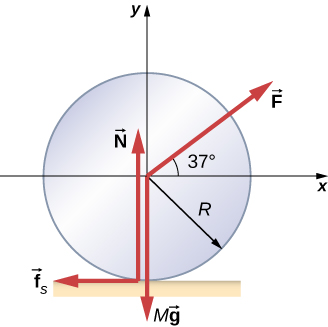
A hollow cylinder is given a velocity of v.0 thousand/south and rolls up an incline to a height of 1.0 chiliad. If a hollow sphere of the same mass and radius is given the same initial velocity, how high does information technology roll upwards the incline?
[reveal-answer q="fs-id1165038369522″]Prove Solution[/reveal-answer]
[hidden-answer a="fs-id1165038369522″]
Use energy conservation
![\[\frac{1}{2}m{v}_{0}^{2}+\frac{1}{2}{I}_{\text{Cyl}}{\omega }_{0}^{2}=mg{h}_{\text{Cyl}}\]](https://opentextbc.ca/universityphysicsv1openstax/wp-content/ql-cache/quicklatex.com-7501554ade2b943c05bb63ebf3e35d58_l3.png "Rendered by QuickLaTeX.com")
,
![\[\frac{1}{2}m{v}_{0}^{2}+\frac{1}{2}{I}_{\text{Sph}}{\omega }_{0}^{2}=mg{h}_{\text{Sph}}\]](https://opentextbc.ca/universityphysicsv1openstax/wp-content/ql-cache/quicklatex.com-f4e0c2d4d41daa500bfd825f1aa8d9a1_l3.png "Rendered by QuickLaTeX.com")
.
Subtracting the two equations, eliminating the initial translational free energy, nosotros have
![\[\frac{1}{2}{I}_{\text{Cyl}}{\omega }_{0}^{2}-\frac{1}{2}{I}_{\text{Sph}}{\omega }_{0}^{2}=mg({h}_{\text{Cyl}}-{h}_{\text{Sph}})\]](https://opentextbc.ca/universityphysicsv1openstax/wp-content/ql-cache/quicklatex.com-77945b475ab463f04f036bce5d58dd56_l3.png "Rendered by QuickLaTeX.com")
,
![\[\frac{1}{2}m{r}^{2}{(\frac{{v}_{0}}{r})}^{2}-\frac{1}{2}\frac{2}{3}m{r}^{2}{(\frac{{v}_{0}}{r})}^{2}=mg({h}_{\text{Cyl}}-{h}_{\text{Sph}})\]](https://opentextbc.ca/universityphysicsv1openstax/wp-content/ql-cache/quicklatex.com-022071d0d8c835aa3ebbf40789666b50_l3.png "Rendered by QuickLaTeX.com")
,
![\[\frac{1}{2}{v}_{0}^{2}-\frac{1}{2}\frac{2}{3}{v}_{0}^{2}=g({h}_{\text{Cyl}}-{h}_{\text{Sph}})\]](https://opentextbc.ca/universityphysicsv1openstax/wp-content/ql-cache/quicklatex.com-0e097fa185151935e13b67f907860dac_l3.png "Rendered by QuickLaTeX.com")
,
![\[{h}_{\text{Cyl}}-{h}_{\text{Sph}}=\frac{1}{g}(\frac{1}{2}-\frac{1}{3}){v}_{0}^{2}=\frac{1}{9.8\,\text{m}\text{/}{\text{s}}^{2}}(\frac{1}{6})(5.0\,\text{m}\text{/}{\text{s)}}^{2}=0.43\,\text{m}\]](https://opentextbc.ca/universityphysicsv1openstax/wp-content/ql-cache/quicklatex.com-9f6fad420d767cd567a54a318d93e6ad_l3.png "Rendered by QuickLaTeX.com")
.
Thus, the hollow sphere, with the smaller moment of inertia, rolls up to a lower height of
![\[1.0-0.43=0.57\,\text{m}\text{.}\]](https://opentextbc.ca/universityphysicsv1openstax/wp-content/ql-cache/quicklatex.com-9b10cdafe6a3f0bd308862b9507c4f4d_l3.png "Rendered by QuickLaTeX.com")
[/subconscious-answer]
Glossary
- rolling move
- combination of rotational and translational motion with or without slipping
Source: https://opentextbc.ca/universityphysicsv1openstax/chapter/11-1-rolling-motion/
0 Response to "Motion Diagram Car Speeds Up Stops Then Speeds Up Again"
Post a Comment