what can be done to combat the rising population of delinquent female youths
4. Provide Opportunities for Children and Youth
Overview
What future do children envision for themselves? What opportunities are presented to them as they abound up? Many children abound upwardly among poverty, violence, and illness. They see their families, friends, and communities suffering from the effects of alcoholism, unemployment, incarceration, AIDS, or a lack of educational opportunities. Many children, however, are resilient and manage to succeed despite a negative environment. Although not all children are faced with adverse circumstances, our Nation'southward well-being requires that every child in every customs be guaranteed the opportunity to reach his or her full potential.
Providing children with the opportunity to develop positive behaviors is the foundation of most efforts to prevent youth criminal offense and violence. For nearly three decades, educators, policymakers, and criminal justice professionals accept sought effective crime prevention strategies. Although some communities are experiencing success, the state is plagued with escalating juvenile violence, which has compelled policymakers to turn their attention from prevention to "get tough" approaches. But we know now what works. Effective strategies include comprehensive approaches that provide opportunities for education, mentoring, disharmonize resolution grooming, and prophylactic; engage youth and their families; and are community-based and integrated.ane
This section of the Action Plan emphasizes the importance of enhancing delinquency prevention efforts and coordinating them throughout the community. It focuses on what we know nigh factors that put youth at risk of becoming delinquent or serious and vehement offenders likewise as those that protect youth. It encourages communities to accept steps to reduce characteristics that contribute to delinquency while strengthening characteristics that nurture youth. This section emphasizes the importance of truancy reduction and condom school programs and illustrates the Coordinating Council'due south strong support of youth involvement in customs crime and violence prevention strategies. The section concludes that positive youth skill building, through mentoring, conflict resolution, and customs service, can piece of work to prevent or reduce juvenile malversation and serious juvenile violence, especially when coordinated with broader communitywide efforts.
Electric current Status and Analysis of the Problem
Most adolescents are on a healthy path to productive developed lives. There is evidence, even so, that 25 percent of adolescents are at significant take chances of veering off that path because they frequently engage in behaviors with negative consequences, such equally alcohol or other drug abuse, unprotected sexual activity, delinquency, or violence. Another 25 percent of adolescents, who engage in fewer of these behaviors, are at moderate gamble.ii
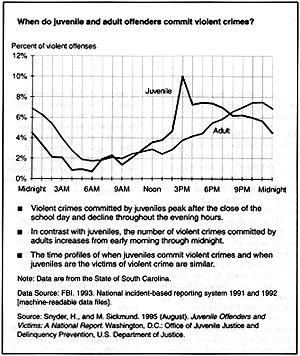
A 1992 study conducted by the Carnegie Foundation determined that simply 60 percent of an adolescent's nonsleeping time is taken up by school, homework, chores, meals, or employment. Many adolescents spend the remaining 40 percent of their nonsleeping time lonely, with peers without adult supervision, or with adults who might negatively influence their beliefs.three A contempo study found that 27 percent of eighth graders spent two or more hours alone later on school and that low-income youth were more likely than others to be home alone for 3 or more hours.4 Information technology is non surprising, therefore, that most trigger-happy crimes committed by juveniles take place at the close of the school day, when fewer opportunities for constructive activities are available. (See figure 11.)
In recent years, the chapters of America's low-income rural and urban communities to provide critical positive activities or environments has declined. Public schools in many areas have deteriorated, and the quality of public education has been compromised. City parks and recreation centers are in busted, and financial support for youth facilities and programs has decreased,v leaving high-hazard environments for youth.
The demand for an immediate solution to this problem, which commands considerable public attention, has been compounded past a historical impatience with prevention strategies in which results may be long in coming and benefits -- that is, crimes not committed -- are extremely hard to measure out. The skillful news, however, is that three decades of seeking effective prevention strategies finally take netted results.
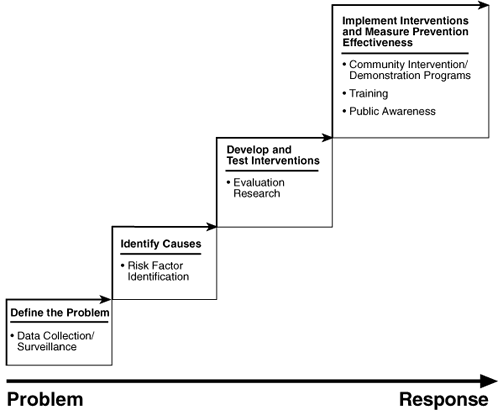
The public wellness model has been specially useful in developing a strong scientific process and assessment of prevention activities. (Come across figure 12 for a public health model for prevention.)
Figure eleven: Tearing crime occurrence times
Risk Factors for Delinquency
Some youth lack healthy parental guidance and monitoring. Some youth take cognitive and psychological deficits that make social and academic success difficult. Some attend disorganized and disruptive schools and fail to engage in academic pursuits. Some live in cluttered neighborhoods with few resources or outlets for positive social activities. Some are excluded from prosocial peer groups and have few, if any, wholesome friends.
These adventure factors, particularly when several are present, increment the likelihood of delinquency and violence. Weather condition such as maltreatment or neglect by family unit members and others, a community with a big population of delinquent juveniles and gangs, gear up access to drugs and guns, and an unsafe school increase the hazard that a youth will make unhealthy or unlawful choices.
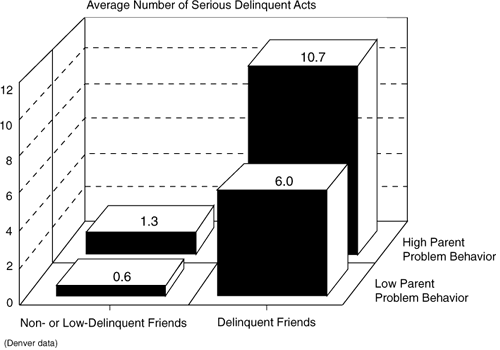
The written report of Causes and Correlates of Delinquency, sponsored by the Office of Juvenile Justice and Delinquency Prevention (OJJDP),6 found the influence of peers and parents to be stiff take a chance factors in the causes of delinquency. (Meet effigy thirteen.)
Protective Factors
Some youth who experience child corruption, neglect, poverty, poor health, or other gamble factors do not get juvenile delinquents, schoolhouse drop-outs, or teenage parents. These youth have the benefit of a combination of protective factors that help guide them in making good for you choices.
A resilient temperament and the development of close relationships with parents and other role models who provide encouragement, good for you beliefs, and clear standards of beliefs offering protection from negative environmental influences.7 In general, healthy youth have resource in their families and communities that assistance them control their behavior and provide them with the skills and opportunities to be successful. Often referred to as protective factors, these resources reduce the take chances that youth will become involved in serious delinquency.
Prevention strategies seek to reduce existing risk factors and provide protective factors that are missing from a youth's surround. In many means, prevention strategies endeavor to provide for at-run a risk children what effective parents and communities provide in the natural grade of youth development. The most effective prevention strategies attend to family and customs deficits over a sustained period of fourth dimension.
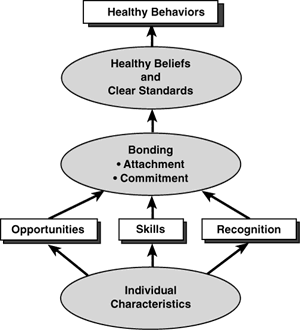
The Social Development Strategy suggests that opportunities, skills, and recognition atomic number 82 to healthy behaviors. (See figure 14.) The underlying theme of this strategy is to reduce take chances factors and increase protective factors in the lives of at-risk children. The identification of hazard factors and protective factors has been an important step in prevention, assisting educators and practitioners in developing more effective programs for youth.
Figure 12: Public health model for prevention
Source: Mercy, J.A., M.Fifty. Rosenberg, K.Due east. Powell, C.5. Broome, and W.L. Roper. Public health policy for preventing violence. Health Affairs. 1993 (Winter): 15. V12 N4.
Experts studying the impact of cultural influences on youth believe that weather condition such every bit poverty, unemployment, discrimination, poor wellness, poor didactics, and despair lay the foundation for alcohol and other drug-related issues. These conditions must be alleviated. Gamble factor inquiry has become more comprehensive and now includes the following domains: individual, family, schoolhouse, peer group, and community. Protective factor research, however, has primarily identified strategies that focus on the individual. Although it is important to focus on increasing skills or abilities of the individual, it is equally imperative to focus on irresolute and improving social systems that create these conditions. The following elements increase the likelihood of successful alter:
- Protective factors in the family unit, including having parents who demonstrate dearest and caring for their children, who are involved in their children'due south activities, and who monitor and supervise their children's behaviors. Other family-oriented protective factors include family stability and adequate financial resources.
- Positive personal attributes such as intelligence, a steady disposition, social skills (including the ability to solve issues without resorting to violence), and a conventional belief organization.
- Schools that positively shape behavior of young children and teenagers due to stiff policies on violence and drugs. Teachers who care nigh students and demonstrate concern for their students' social and academic growth also help to ensure successful development. When youth are prepared for school, succeed in school, and are committed to the education arrangement, they are less likely to become delinquents.
- Communities that provide opportunities and social controls. Communities that exhibit a loftier level of organisation and cooperation, with neighbors working together to run into common objectives, aqueduct youth behavior toward positive outcomes. For example, communities with agile PTA's, afterschool activities, churches and religious organizations, and youth social clubs aid to protect youth from the temptations and hazards that exist in society.
- Youth participation in and acceptance by prosocial peer groups. Peer influence is particularly important during adolescence.
- Adult supervision of and interest in youth peer group activities, to provide added protection against developing delinquent behavior.
Figure 13: Influence of parents and peers on delinquency
Data Source: Program of Enquiry on the Causes and Correlates of Delinquency. 1993. (November). Urban Delinquency and Substance Corruption, technical report.
Source: Thornberry, T.P., D. Huizinga, and R. Loeber. 1995. Sourcebook on Serious, Fierce, and Chronic Juvenile Offenders. Thousand Oaks, Calif.: Sage Publications.
Cumulative Impact of Protective Factors
Good for you growth and development are most likely to occur when protective factors are sustained throughout these areas of influence. A nurturing family, positive friendships, a good education, and career opportunities combine as important factors to ensure positive outcomes for youth, not simply in preventing delinquency only also in preventing substance abuse, violent beliefs, teenage pregnancy, and school dropout. Parents should attempt to provide their children with this constellation of protective factors continuously over the course of their evolution.
Comprehensive Delinquency Prevention
The all-time delinquency prevention strategies are comprehensive, reducing risk and developing protective factors in each child and in families, schools, communities, and peers. Researchers have plant that collective strategies with multiple protective programs, rather than those that address single risk factors, accept a sizable impact on reducing delinquency.eight Activities that accept place nether ane roof in the community and that reflect the cultural values of participants are more likely to engage the individuals they are meant to serve. This means that to effectively reduce youth violence, strategies must engage the entire spectrum of systems and individuals impacting a young person's life.
Serious malversation and youth violence are almost likely to occur in youth exposed to multiple run a risk factors, multiple deficits of protective factors, and multiple concurrent problem behaviors. Consequently, prevention strategies need to deal simultaneously with a host of issues and crave comprehensive strategies. Moreover, considering gamble factors and concurrent problem behaviors tend to interact with one another, it is important that prevention strategies deal with all of these factors in an integrated fashion. This recommendation is consistent with what we know about resilient youth. Even high-run a risk youth can avoid involvement in malversation if they experience many protective factors.9
Improving education and youth employment opportunities, enhancing social skills, and providing youth with mentors and developed role models are essential components of delinquency prevention. 3 decades of research betoken that increased opportunities for success, meaningful activities, positive role models, consistent moral standards, and viable educational and employment opportunities have a prominent place in the Nation'due south crime command strategy.
Decades of research also demonstrate that malversation prevention is cost effective. According to i bourgeois estimate, the boilerplate cost of incarcerating a juvenile for 1 year is close to $34,000.10 Others put the effigy betwixt $35,000 and $64,000.11 In improver, the total cost of a young adult'due south (ages 18 to 23) serious, violent criminal career is estimated to be $1.1 million.12 In contrast, the current cost of Caput Outset'due south intervention program, which is effective in developing school readiness skills among high-take chances children and reduction in later delinquency, is $four,300 per yr per child. Similarly, a delinquency prevention program in California produced a directly savings to law enforcement and the juvenile justice organization of $1.twoscore for every $1 spent on prevention.13
Figure fourteen: Social development strategy
Source: Howell, J.C., ed. 1995 (May) Guide for Implementing the Comprehensive Strategy for Serious, Violent, and Chronic Juvenile Offenders. Washington, D.C.: Office of Juvenile Justice and Delinquency Prevention, U.S. Department of Justice.
Effective and Promising Strategies and Programs
Delinquency Prevention Works
We know that there are effective programs that reduce malversation and testify promise for stemming the rising tide of delinquency and youth violence. Materials on this inquiry published by OJJDP and others summarize much of the handling and evaluation literature and identify model programs that are worthy of replication. Among the best of these reports are those of Lipsey,14 Tolan and Guerra,15 Howell,16 Thornberry,17 and Mendel.eighteen
Truancy Reduction
Too many of America'due south young people attend school on an irregular basis, resulting in their failure to proceeds a solid foundation of basic academic skills. These young people accept not notwithstanding officially dropped out of school and they are not on an extended absence due to illness. They are truants -- at risk of academic failure and dropping out of school at age 16, or earlier, and never obtaining the skills necessary to go contributing members of lodge. Truancy has been rated among the top 10 problems facing schools, with the daily absentee charge per unit equally high as xxx percent in some cities. As a number of studies have documented,xix high rates of truancy are linked to high daytime burglary rates and vandalism. Truancy is not a trouble restricted to the pedagogy and constabulary enforcement communities. It has an even more of import impact on the truant's ability to learn, develop interpersonal relationships, and ultimately complete school and gain the cognition and skills necessary for higher education and/or future employment. In order to comprehensively address the truancy problem, a range of interested parties must join together to coordinate a response. These parties include schools, constabulary enforcement agencies, parents, businesses, judicial and social services agencies, and community and youth organizations.
Communities have a responsibility to provide an appropriate educational activity for all youth in a disciplined, safe, and secure environment. Yet school systems are oft presented with students who have specific instructional and/or social problems that arrive difficult to achieve in the regular school environment with a traditional curriculum. A host of problems from the home and the community emerge in the classroom and require special treatment. Teachers may observe signs of hunger, kid abuse, neglect, alcohol or other drug abuse, learning disabilities, developmental issues, socialization problems, beliefs disorders, gang involvement, and a general lack of school readiness.
In social club to provide prevention and early intervention for youth at risk of truancy, as well every bit youth who are truant, the school organization needs the active support and participation of parents, students, the community, constabulary enforcement, and businesses. A number of jurisdictions across the state have truancy prevention and intervention programs that are collaborative initiatives, and they are listed in the National School Safety Heart publication Increasing Student Attendance.twenty In addition, the National Council of Juvenile and Family Court Judges' (NCJFCJ) report, A New Approach to Runaway, Truant, Substance Abusing and Beyond Command Children,21 describes innovative processes and approaches that private communities might adopt to more than adequately address this population of youth. NCJFCJ has too updated its Disposition Resource Manual22 that informs judges and juvenile court personnel about various programs that concord promise or have proven positive results. Within the Transmission, several programs are provided that address the problem of truancy.
Truancy reduction programs are having positive furnishings on both school omnipresence and juvenile crime. A truancy reduction program in the Oklahoma City public schoolhouse system reported a steady decline in the dropout rate from v.9 percent to 4.1 pct during the 1991-92 school twelvemonth.23 The Truancy Habits Reduced, Increasing Valuable Education (THRIVE) program is a partnership between the school system and police enforcement to reduce truancy and crime during school hours. Police enforcement officers bring in juveniles who are out of school without an excuse and notify parents who must pick up their children. If parents cannot be located, juveniles are sent to the Oklahoma County Youth Services Agency until they can be picked up.
Some other truancy prevention program impacting elementary and middle schoolhouse attendance and disciplinary referrals is Self Enhancement, Inc. (SEI) of Portland, OR. SEI is a community-based organization that began in 1981 and has served more than than 12,000 inner-urban center school students. The program offers classroom education, extracurricular activities, cultural enrichment, career counseling, and summer outreach for 450 high-chance children every year. SEI staff work with participants in their schools, provide tutoring, encourage bookish excellence, and respond to crises in the school.
In addition, SEI sponsors field trips, sporting activities, and afterschool supervision. A key component of the program is for staff to work with families and help parents become more agile in preventing truancy. In 1994, SEI participants had improved school attendance and disciplinary referrals dropped dramatically. Students in elementary school raised their grades by 47 percentage and middle school students by lxx percent.24
Mentoring
Mentoring has been defined equally a "sustained, shut, developmental relationship betwixt an older, more experienced private and a younger person, with the goal of building character and competence on the part of the protégé."25 Usually the human relationship involves regular contact over a sustained menses of time and involves common delivery, respect, and loyalty.
Mentoring has proved to be a valuable strategy for helping disadvantaged youth. A mentoring relationship tin enrich children's lives, accost the isolation of some youth from adult contact, and provide support and advocacy for at-adventure children. Inquiry has indicated that mentoring relationships tin have a positive impact on a youth's attitudes toward alcohol, tobacco, and drug use.26 Other studies certificate the positive effects of cross-cultural mentoring.27
Bigs in Blueish is an innovative mentoring program adult by the Big Brothers/Big Sisters of Warren County, NJ, that matches at-risk youth with police force officeholder mentors. They use prevention and intervention strategies to aid youngsters from chaotic dwelling house environments cope with peer pressure, succeed in school, receive career guidance, and make audio life choices. Evaluations completed by parents, volunteers, and youth indicate reductions in delinquency and court involvement and improvement in school attendance, behavior, and grades.28
Robert Taylor Homes in Chicago, IL, the largest public housing development in the state, has implemented a Mentoring and Rites of Passage program designed to assist adolescents in their transition to machismo. Mentors meet with groups of 10 to 15 youths of similar ages at to the lowest degree twice a calendar week and accost such areas as self-concept, sexual identity and awareness, communications and decisionmaking, and cultural heritage appreciation. Evaluations of participants are conducted every vi months to runway their interpretation of standard social interactions and situations, cocky-reported violent behavior and self concept, infirmary visits related to violence, and calls to the police about violent events in the housing project.
Conflict Resolution
Conflict resolution encompasses artistic problemsolving strategies in which parties in dispute collaborate by expressing their points of view, voicing their interests, and finding mutually acceptable solutions. Disharmonize resolution programs recognize that conflict is natural and that people can learn new skills to deal with conflict in advisable, nonviolent ways. The programs appear to be virtually effective when they are comprehensive and involve multiple components such as moral reasoning, acrimony control, social skills development, and collaborative problemsolving methods.
William DeJong, a lecturer at the Harvard School of Public Health, reports in the 1994 fall issue of School Safety: "The best school-based violence prevention programs seek to exercise more than achieve the individual kid. They instead try to change the total school surroundings, to create a safety community that lives by a ideology of nonviolence and multicultural appreciation."29 Effective disharmonize resolution programs achieve the following goals:
- Enable children to reply nonviolently to conflict, using the conflict resolution strategies of negotiation, arbitration, and grouping problemsolving.
- Develop educators' competence to manage beliefs in school without coercion, using a program that teaches students responsibleness and self-discipline.
- Mobilize customs involvement in violence prevention through education programs and services, such as expanding the function of youth every bit effective citizens beyond the school into the community.
Conflict resolution programs in schools generally autumn into ane of three models: mediation, curriculum integration, or peaceable schools. The peaceable schools model synthesizes the elements of the start two models.
Recognizing the importance of straight involving youth in conflict resolution, many schoolhouse communities are employing peer mediation equally a violence prevention strategy. In these programs, specially trained student mediators work with their peers to find resolutions to conflicts. Mediation programs reduce the use of traditional disciplinary actions such as intermission, detention, and expulsion; encourage effective problemsolving; decrease the need for teacher involvement in student conflicts; and ameliorate schoolhouse climate.
An case of a mediation programme is We Tin can Work Information technology Out, developed by the National Institute for Citizen Education in the Police and the National Crime Prevention Council. The program promotes arbitration, negotiation, or other nonlitigating methods as strategies to settle unresolved confrontations and fighting. The program emphasizes the importance of showing students that many of the issues that are oft taken to court might be solved more effectively through cooperative methods, such as peer arbitration.
In the curriculum integration arroyo, teachers deliver daily lessons in conflict resolution, infuse conflict resolution concepts and skills into cadre curriculum areas, and model effective disharmonize resolution in their management of the classroom. Promoting Alternative Thinking Strategies (PATHS) is a curriculum integration approach to disharmonize resolution for children from kindergarten through sixth grade. Information technology is designed to enhance the social competence and agreement of elementary school children and to facilitate educational processes such as self-control, emotional awareness, and interpersonal problemsolving skills that are integrated into the curriculum. An evaluation of PATHS shows that the programme is effective for both low- and high-risk children in increasing management and agreement of emotional experiences.thirty
Peaceable school programs seek to create schools in which conflict resolution has been integrated at every level. Ultimately, conflict resolution skills are adopted by every member of the school community, creating a school climate that encourages caring, honesty, cooperation, and appreciation for diversity. Peaceable school programs contain disharmonize resolution skills and noncoercive schoolhouse and classroom management strategies directly into the classroom curriculum. Peaceable schools challenge youth and adults to believe and act on the agreement that a nonviolent, diverse order is a realistic goal.
In schools in New York and other cities, the Resolving Conflict Creatively Program (RCCP) is implemented as a peaceable schools model of conflict resolution. The RCCP approach requires schools to participate in the curriculum for a yr or more; in schools with a strong core of teachers who regularly utilise the curriculum, the student mediation plan may exist added. The RCCP approach to conflict resolution integrates 2 chief components: the RCCP unproblematic and secondary curriculum and the RCCP pupil mediation program. A tertiary component -- the parent grooming curriculum -- introduces RCCP principles into the abode to send youth a consistent message from parents and teachers, who thus reinforce each other on this crucial issue.
Safe Schools and Rubber Havens
Community schools and family centers provide youth with safe spaces for productive alternatives to occupy out-of-schoolhouse and weekend time. They besides provide a central space for integrating various promising strategies and programs, such as mentoring, conflict resolution, and employment training. These programs generally provide a range of educational, recreational, and cultural activities in a supervised environment with trained staff.
For years Boys and Girls Clubs of America take been engaged in comprehensive strategies to help their members build cocky-esteem, acquire honest values, and pursue productive futures. These clubs too work specifically to prevent gang involvement. Supported in function past Federal funding, the clubs have developed partnerships with corporations, private foundations, individuals, and regime agencies. According to a Columbia Academy study, Boys and Girls Clubs have been constructive in increasing rates of school attendance and improving academic performance. In addition, Clubs in public housing projects accept reduced the juvenile crime rate by thirteen percent.31
Members of the Corporation for National Service's (CNS') AmeriCorps program have established a Prophylactic Corridors plan in eight elementary schools in Philadelphia. The programme is designed to ensure the safe passage of youth to and from school past using 80 parent volunteers who patrol the streets around the schools in the mornings and afternoons. The volunteers blueprint the program structure, uniforms, and policies, and are responsible for recruiting other parents to deport out the plan. The Safe Corridors program has been and so successful in increasing safety that the city is offering it equally a model for statewide implementation.
In Seattle, WA, AmeriCorps members staff seven Rubber Haven sites that provide an opportunity for 1,000 at-risk youth to participate in workshops, tutoring and mentoring programs, and conflict resolution sessions. The programs are designed to increase self-esteem, provide educational opportunities, and reduce violent behavior.
National and Community Service Opportunities
CNS, established in 1993 to appoint citizens of all ages and backgrounds in customs service, operates AmeriCorps and Acquire and Serve America. AmeriCorps participants provide a year or two of public service in exchange for education awards to finance college or other educational training or to pay back pupil loans. Volunteers have helped elementary school students ameliorate their reading skills and scores in Kentucky, patroled recreation areas in New York City, assisted constabulary enforcement and community members in endmost crack houses in Kansas Urban center, and helped residents recover from natural disasters in California and the Midwest.
Through the Acquire and Serve America program, school-age youth serve their communities by educational activity younger students well-nigh violence prevention; designing criminal offence prevention and public safe exhibits for local fairs; helping other youth to combat negative peer force per unit area; eliminating graffiti in their communities; establishing Junior Neighborhood Picket programs; and helping to identify concrete problems in the community, such as broken lighting, overgrown foliage that blocks articulate views of public places, and run-downwards parks.
One example of an constructive community-building programme is the Teens every bit Resources Against Drugs (TARAD) project, funded by the Agency of Justice Aid. This youth-led prevention program combats delinquency by inspiring teens to fight drug action in their communities. Teens in New York City, Evansville, IN, and three South Carolina communities led the way in their schools and neighborhoods by creating anti-drug messages on murals; disseminating accurate facts about drugs and instruction their peers healthy life choices; writing, choreographing, and producing plays and puppet shows dramatizing the dangers of drug utilize; and organizing community events such as fairs and substance-free New year's Eve parties. The teens written report positive attitude changes nearly drug use amongst their peers. Another measure of success is that local agencies, groups, and organizations have assumed funding of well-nigh of the programs.32
Federal Action Steps
Launch an Initiative To Accost the Problem of Youth Outside the Educational Mainstream
The Section of Justice (DOJ) and the Department of Education (ED) will implement a joint initiative directed at youth who are in danger of leaving or who have left the educational mainstream. The initiative volition raise public awareness of this increasing problem and place effective and promising programs that are finding solutions. It will provide assistance to selected jurisdictions and sites to develop or enhance programs for youth outside the educational mainstream, including youth who are truant, dropouts, afraid to get to school, suspended, or expelled (for example, for weapon possession), or need to be reintegrated into the mainstream from the juvenile justice organisation.
To help achieve the goals and objectives of this initiative, 4 regional forums and 10 grooming and technical assistance programs will be held to address the needs of these youth. One component volition be a partnership between schools, police enforcement, and juvenile and family unit court judges. Collaborative efforts will focus on prevention, early on intervention, and supportive services.
Provide Mentoring Opportunities for Youth
OJJDP volition provide programmatic back up, technical assistance, and training to 41 mentoring programs, funded under the Juvenile Mentoring Program (JUMP).
The Interagency Council on Mentoring, which includes representatives from the Domestic Policy Council; the Departments of Wellness and Human Services (HHS), Labor (DOL), Defence force, Instruction, and Justice; and the CNS, volition continue to identify existing mentoring programs, investigate research issues, and explore opportunities for collaboration. The Quango is publishing a study entitled Making the Most of Mentoring, which summarizes current mentoring efforts and proposes a three-part mentoring strategy.
Provide Guidance on Schoolhouse-Based Conflict Resolution Programs
OJJDP, in partnership with ED, will publish a guide and provide training seminars to help school administrators, teachers, and other interested parties sympathize the concept of disharmonize resolution and its usefulness in preventing violence and teaching positive life skills. The guide will be a tool for schools and communities to use in their strategic planning for implementing effective conflict resolution programs that meet their specific needs. Past answering typical questions asked about conflict resolution, the guide will requite readers a description of the essential elements of constructive school-based conflict resolution programs, besides as information useful for establishing and sustaining conflict resolution programs in their schools. Half-dozen case studies incorporating models of peer mediation, curriculum integration, and peaceable schools will exist included in the guide. Other helpful features include annotated lists of conflict resolution programs, resource, and trainers with contact data.
Increase Schoolhouse Safety To Better Opportunities for Learning
Federal reforms such as the reauthorization of the Elementary and Secondary Educational activity Human activity (ESEA), Educate America: Goals 2000, and School to Work Transition are first steps in addressing the crunch facing our public schoolhouse arrangement. Title I, Office A of ESEA provides grants to States to support standards-based educational reform and improve the ability of schools to assistance educationally disadvantaged children. Before these improvements can exist effective, however, students must be assured that they can learn in a safe surround.
ED'south Rubber and Drug-Gratuitous Schools Plan (SDFSP) was established in 1994 to provide a comprehensive, coordinated approach to prevention of school violence and alcohol, tobacco, and drug apply past young people. SDFSP administers State formula grant and discretionary grant programs and too provides technical assistance to schools in the development of comprehensive programs to preclude violence and drug employ.
The National Institute of Justice (NIJ) will provide funding to assess the effectiveness of the organizational structure and operation of a multifariousness of these programs nationwide. This assessment volition try to determine how school-based drug prevention programs, such every bit Drug Awareness Resistance Educational activity (DARE), can be tailored to improve come across the needs of specific populations. The study volition likewise recommend new structures and operations to improve and expand Dare and other existing drug prevention education programs.
NIJ will also do the following:
- Fund evaluations of school-based programs aimed at reducing youth violence and promoting school safety.
- Support a study of juveniles who have been involved in school violence in an attempt to clarify the dynamics leading to violence. The information gathered from this study will be used to pattern and implement a school curriculum that better addresses those dynamics.
- Explore risk factors that contribute to delinquency (relationships amidst school discipline and control practices, beliefs problems, in-school victimization, and school location) and school offense. This will exist achieved through analysis of data from interviews of students, teachers, and principals.
HHS has provided funds through the Community Schools/FACES grant programs to support the evolution or expansion of programs that are designed to improve the bookish and social development of at-risk students at selected public schools in eligible communities. Activities in these schools include homework assist and afterschool activities, such as educational, social, and able-bodied programs; nutrition services; mentoring programs; family counseling; and parenting programs.
To assist in ensuring the safe of these and other sites, OJJDP will support the National School Safety Center in providing training and information on schoolhouse safety techniques through the School Administrators for Effective Constabulary, Prosecution, and Probations Operations Leading to Improved Children and Youth Services (SAFE POLICY) programme. This program addresses the problem of increased serious juvenile violence in schools. A team of school personnel develops strategies for sharing information and improving school prophylactic, equally well as supervision, command, and delinquency prevention.
Provide Youth With Activities That Encourage Positive Youth Development
To ensure that resource and family centers can implement programs, the Department of Housing and Urban Development'due south (HUD's) National Youth Sports Grants volition provide funds for positive alternative activities for at-risk youth, including sports, recreational, cultural, and educational programs. This grant program is a vehicle for youth to develop leadership skills, gain self-esteem, larn the value of teamwork, and do self-empowerment in a positive and drug-complimentary surround.
OJJDP's Pathways to Success will promote business, entrepreneurial, educational, recreational, and chore skills, also equally arts programs for afterschool and weekend hours. In addition, OJJDP'south grant with the Academy for Educational Development volition back up the development of a curriculum that trains youth workers to apply a youth development approach.
Provide Training and Opportunities for Youth Employment
HUD volition continue to fund the YouthBuild plan, which works with AmeriCorps to aid disadvantaged immature adults who have dropped out of high school obtain employment and pedagogy skills that will help them achieve economic self-sufficiency.
To encourage the involvement, investment, and participation of educators, businesses, students, and parents, DOL's School-to-Piece of work Opportunities Initiative will integrate a career employment, education, and learning program. The program will be geared to all youth to prepare them for the highly technological and rapidly evolving workplace. The link between unemployment and lack of opportunities and delinquency is strong, and a national delivery to this issue is critical. DOL administers the Job Corps to address the multiple barriers to employment faced past disadvantaged youth. Job Corps, which serves about 60,000 youth each twelvemonth, provides a comprehensive mix of coordinated and integrated services in one facility. These services aid immature adults to become more responsible, employable, and productive citizens.
The Department of the Interior and OJJDP will jointly sponsor the Youth Environmental Services (Yes) program. The purpose of the YES program is twofold:
- To increment the capacity of States and communities to correct, care for, and rehabilitate adjudicated delinquents.
- To prevent at-risk youth from entering the juvenile justice system by implementing environmental piece of work programs on federally endemic land.
In improver, OJJDP will explore opportunities to include loftier-chance and juvenile court-involved youth in employment and preparation programs.
Establish and Support Family-Based Customs Centers That Integrate Service Delivery Through a Range of Promising Prevention Programs
HHS will continue to fund community-based family resource programs to help States develop and implement, or expand and heighten, comprehensive statewide systems of family resource services. These services will be provided through innovative funding mechanisms and collaboration with existing education, vocation, rehabilitation, health, mental health, employment and training, child welfare, and other social service agencies. The goal will be to reduce barriers to the commitment of high-quality, community-based services for families, with an emphasis on interagency collaboration, service integration, public and private partnerships, interdisciplinary governance of pb agencies, and total partnership betwixt families and professionals.
HUD awards grants to public housing government to provide families and youth with amend admission to education and employment opportunities. The objective is to aid these individuals accomplish economic self-sufficiency, improve their quality of life and, ultimately, decrease drug and crime bug. In 1995, $10 meg was made available to support the Family Investment Centers and Youth Development initiative sites that are providing youth-related activities and services such as training and aid in obtaining General Equivalency Diplomas (GED's) and entrepreneurship skills.
NIJ volition continue to support an evaluation of the Boys and Girls Clubs programme in public housing.
Provide Opportunities for Youth To Serve Their Communities
CNS will continue to institute total- and part-fourth dimension community service programs such as AmeriCorps and Learn and Serve America, which involve individuals of all ages in violence reduction initiatives and other public service activities. These include schoolhouse-based initiatives for kindergarten through twelfth course and higher teaching programs that make service an integral role of college teaching.
OJJDP will continue to support Teens, Crime, and the Community, a program conducted by the National Criminal offence Prevention Council and the National Plant for Citizen Instruction in the Law, that seeks to direct the energies of immature people toward constructive activities designed to reduce criminal offense and violence.
All Federal agencies administering programs that address the problem of juvenile violence volition encourage communities to include youth in the planning and implementation of their programs.
Coordinate Federal Crime Prevention Programs
In that location is a substantial need to coordinate Federal programs that are designed to prevent and intervene in specific youth problems, improve the environments in which youth live, and foster the overall positive evolution of youth. The President's Law-breaking Prevention Council, created by the 1994 Tearing Crime Command and Law Enforcement Act, has published and disseminated a delinquency prevention catalog that highlights major Federal programs and offers guidance for communities seeking to plan and implement comprehensive law-breaking prevention strategies. Over the adjacent year, the Prevention Council will work to place ways to coordinate and integrate existing Federal prevention programs to ensure better collaboration and to maximize their impact on communities.
Suggestions for Land and Local Activity
- Constitute and enhance programs that bring together teachers, school administrators, social service providers, police, juvenile justice practitioners, and citizens.
- Develop partnerships between parks and recreation agencies, libraries, public housing agencies, customs centers, and gymnasiums to furnish safe sites for positive activities for youth.
- Abet volunteerism for mentoring and tutoring programs.
- Develop safe passage customs patrols to ensure that youth get to and from school safely.
- Invite parents, police force enforcement officers, business leaders, and others into schoolhouse buildings to provide additional supervision and positive role models.
- Provide students with the skills and noesis necessary to manage their behavior and resolve conflicts in a nonviolent manner.
- Implement developmentally appropriate conflict resolution programs for students at all grade levels.
- Aggrandize existing programs to include artistic and cultural activities, and implement activities designed to promote the values of individual and civic responsibility.
- Implement national service initiatives at the local level to provide youth with opportunities to serve their communities.
- Review and modify personnel policies in the individual sector to encourage employees to serve every bit community volunteers with youth.
- Increase funding for youth employment and training programs.
- Review resource allotment of funding to ensure equitable distribution of resources for delinquency prevention programs in schools.
Endnotes
1. Delinquency Prevention Works. 1995 (May). Washington, D.C.: Role of Juvenile Justice and Delinquency Prevention, U.Due south. Department of Justice.
two. Dryfoos, J.M. 1990. Adolescents at Adventure: Prevalence and Prevention. London, England: Oxford Academy Press.
3. Carnegie Quango on Boyish Evolution. 1994 (Apr). A Matter Of Time: Take a chance and Opportunity in the Out-of-Schoolhouse Hours. New York, N.Y.: Carnegie Foundation.
4. National Center for Education Statistics. 1990. National Education Longitudinal Study of 1988: A Profile of an American Eighth Grader. Washington, D.C.: Office of Educational Research and Improvement, U.South. Department of Educational activity.
5. Carnegie Quango, 1994.
vi. Thornberry, T.P., D. Huizinga, and R. Loeber. 1995. The prevention of serious malversation and violence: Implications from the programme of research on the causes and correlates of delinquency. In J.C. Howell et al., eds. Sourcebook on Serious, Trigger-happy, and Chronic Juvenile Offenders. Chiliad Oaks, Calif.: Sage Publications.
7. Hawkins, J.D., and R.F. Catalano, Jr. 1993. Communities That Care: Risk-Focused Approach Using the Social Development Strategy: An Approach to Reducing Adolescent Problem Behaviors. Seattle, Wash.: Developmental Research and Programs, Inc.
8. Ibid.
9. Lipsey, M.W. 1992. Juvenile delinquency treatment: A meta-analytic research into the variability of furnishings. In T.D. Cook et al., eds., Meta-Analysis for Caption: A Casebook. New York, Due north.Y.: Russell Sage Foundation.
10. Cohen, M.A. 1994. The Budgetary Value of Saving a High-Risk Youth. Washington, D.C.: The Urban Institute.
11. Campsite, Thousand.M., and C.Yard. Camp. 1990. Corrections Yearbook: Juvenile Corrections. South Salem, North.Y.: Criminal Justice Plant.
12. Cohen, 1994.
13. Lipsey, 1992.
14. Ibid.
15. Tolan, P., and N. Guerra. 1994 (July). What Works in Reducing Adolescent Violence: An Empirical Review of the Field. Boulder, Colo.: The Middle for the Study and Prevention of Violence, Academy of Colorado.
16. Howell, J.C., ed. 1995 (May). Guide for Implementing the Comprehensive Strategy for Serious, Violent, and Chronic Juvenile Offenders. Washington, D.C.: Office of Juvenile Justice and Delinquency Prevention, U.South. Department of Justice.
17. Thornberry et al., 1995.
xviii. Mendel, R.A. 1995. Prevention or Pork? A Difficult-Headed Wait at Youth-Oriented Anti-Crime Programs. Washington, D.C.: American Youth Policy Forum.
nineteen. Embankment, C. 1983. Truancy and Student Delinquency: A Pilot Report. New York, Northward.Y.: Office of the Mayor, City of New York.
Diebolt, A., and L. Herlache. 1991 (March). The School Psychologist as a Consultant in Truancy Prevention. Tempe, Ariz.: Arizona State Academy.
Levine, B. 1993 (August 16). Tracking Truants. Los Angeles Times, p. E-1.
Pennell, South., C. Curtis, B. McCardell, and P. Kichinsky. 1981. Truancy Project Evaluation: Final Study. San Diego, Calif.: Criminal Justice Evaluation Unit, San Diego Association of Governments.
Stephens, R.D., Due south. Greenbaum, and R.W. Garrison. 1988. Increasing Student Omnipresence: NSSC Resource Paper. Sacramento, Calif.: National School Safety Middle, Pepperdine University.
Truancy, Chronic Absenteeism and Dropping Out. 1989. York, Pa.: William Gladden Foundation.
20. Stephens et al., 1988.
21. New approach to runaway, truant, substance abusing and across control children. 1990. Juvenile and Family Court Periodical 41(3B):9-49.
22. Disposition Resource Transmission. 1990. Washington, D.C.: National Council of Juvenile and Family Court Judges.
23. Beyond Convictions: Prosecutors every bit Customs Leaders in the War on Drugs. 1993. Alexandria, Va.: American Prosecutors Enquiry Institute.
24. Yap, K.O., and J. Pollard. 1992 (October). A Preliminary Evaluation of the Cocky Enhancement, Inc. (SEI) Plan. Portland, Ore.: Northwest Regional Educational Lab.
25. Freedman, M. 1995. Making the Most of Mentoring. Unpublished report. Interagency Quango on Mentoring. Washington, D.C.: Corporation for National and Community Service.
26. LoSciuto, L., and T.North. Townsend. An Outcome Evaluation of "Across Ages"; An Intergenerational Mentoring Program. Philadelphia, Pa.: Institute for Survey Research.
27. Freedman, 1995.
28. Barnes, 50. 1992 (Fall/Winter). Police Officers at Heart of Bigs in Blue Program. Big Brothers/Big Sisters of America.
29. DeJong, W. 1994. "Creating a more peaceful globe," School Condom (Fall 1994): p. eight.
xxx. Greenberg, M.T., et al. 1995. Promoting emotional competence in school-anile children: The effects of the PATHS curriculum. Evolution and Psychopathology 7:117-136.
31. Howell, ed., 1995.
32. Given the Opportunity: How Three Communities Engaged Teens As Resources in Drug Abuse Prevention. 1992. Washington, D.C.: National Criminal offense Prevention Quango.
Contents | Foreword | Acknowledgments | Introduction | Summary
Figures | Objectives | Decision | Appendixes
Source: https://ojjdp.ojp.gov/sites/g/files/xyckuh176/files/action/sec4.htm
0 Response to "what can be done to combat the rising population of delinquent female youths"
Post a Comment