Roman Catholic Readings for Mass for St. Patrick
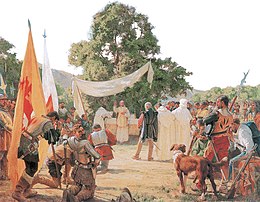
Delineation of the first Mass in Chile, by Pedro Subercaseaux
The Mass is the primal liturgical rite in the Catholic Church, encompassing the Liturgy of the Word (Mass of the Catechumens) and the Liturgy of the Eucharist (Mass of the Faithful), where the bread and vino are consecrated and become the Torso and Claret of Christ.[one] [2] Every bit defined by the Church at the Council of Trent, in the Mass, "the same Christ who offered himself once in a encarmine mode on the altar of the cross, is present and offered in an unbloody manner".[3] The Church building describes the Mass as the "source and acme of the Christian life".[4] Thus the Church building teaches that the Mass is a sacrifice. It teaches that the sacramental bread and vino, through consecration by an ordained priest, become the sacrificial body, blood, soul, and divinity of Christ as the sacrifice on Calvary fabricated truly present once over again on the altar. The Cosmic Church building permits just baptised members in the state of grace (Catholics who are not in a state of mortal sin) to receive Christ in the Eucharist.[v]
Many of the other sacraments of the Catholic Church, such as confirmation, holy orders, and holy marriage, are at present generally administered within the framework of the Mass, but before the Second Vatican Council were oftentimes or even usually administered outside of Mass. The term "Mass" is commonly used of celebration of the Eucharist in the Latin Church, while the various Eastern rites employ terms such as "Divine Liturgy", "Holy Qurbana", and "Badarak",[6] in accordance with each one's tradition. Pope Bridegroom XVI's 2007 motu proprio Summorum Pontificum authorized nether certain weather condition, more widely than before, continued employ of the 1962 form of the Roman Rite, which information technology called the Extraordinary Class of the Roman Rite, while it called the post–Vatican II form promulgated by Pope Paul Half-dozen in 1969 and revised past Pope John Paul II in 2002 the Ordinary Form.[7] [8] On xvi July 2021 Pope Francis in his apostolic letter Traditionis custodes restricted the celebration of the Tridentine Mass of the Roman Rite and declared that "the liturgical books promulgated by Saint Paul Half-dozen and Saint John Paul Ii, in conformity with the decrees of Vatican Council II, are the unique expression of the lex orandi of the Roman Rite."[9]
The term "Mass" is derived from the concluding words of the Roman Rite Mass in Latin: Ite, missa est ('Get, it is the dismissal', officially translated as 'Go forth, the Mass is ended'). The Late Latin discussion missa substantively corresponds to the classical Latin word missio .[ten] In antiquity, missa only meant "dismissal". In Christian usage, however, it gradually took on a deeper pregnant. The give-and-take "dismissal" has come to imply a mission.[11]
Sacrificial nature [edit]
In Catholic teaching, the holy sacrifice of the Mass is the fulfillment of all the sacrifices of the Old Covenant. In the New Covenant, the one sacrifice on the chantry of Calvary is revisited during every Cosmic Mass. Jesus Christ merited all graces and blessings for us by His death on the Cross. These merits form an inexhaustible fountain of grace to nourish the supernatural life of souls. At Calvary, Christ not merely merited all graces for people but besides established certain channels whereby these graces may be obtained. These channels are the Sacrifice of the Mass and the other Sacraments.[12]
The offset Mass was instituted by Christ at the Terminal Supper, on the first Holy Th. The first Holy Sacrifice of the Mass was celebrated on the eve of the Passion. The unbloody sacrifice of the Last Supper is a memorial of Christ's bloody sacrifice on the cantankerous. Thus, the Mass is a unifying event of the Last Supper and Christ's sacrifice on Calvary.
The Mass contains the 4 essential elements of a truthful sacrifice: priest, victim, altar, and sacrifice. Its Priest, Jesus Christ, uses the ministry building of an earthly representative; its Victim, Jesus Christ, truly present under the appearances of breadstuff and wine; its altar; and the Sacrifice is a mystic representation of the claret-shedding of Calvary. Thus, the Mass is offered for four ends: adoration, atonement, thanksgiving, and petition.[12]
History [edit]
The Roman Rite Mass, the predominant grade of its celebration in the Catholic Church, is the focus of this article. For information on the theology of the Eucharist and on the Eucharistic liturgy of other Christian denominations, see "Mass (liturgy)", "Eucharist" and "Eucharistic theology". For information on the history development of the Mass meet Eucharist and Origin of the Eucharist.
The classic study of the Mass is that of Josef Andreas Jungmann, the 2-volume Mass of the Roman Rite or Missarum Solemnia. [13] Paul F. Bradshaw and Maxwell E. Johnson trace the history of eucharistic liturgies from first-century shared meals of Christian communities, which became associated with the Last Supper, to 2nd and third-century rites mentioned by Pliny the Younger and Ignatius of Antioch and described past Justin Martyr and others, in which passages from Scripture were read and the utilise of breadstuff and wine was no longer associated with a total meal.[14]
When in the fourth century Christianity was granted the status of a legal religion and was even viewed with favour past the Roman Emperors, the Christian celebrations took on a more formal appearance and were embellished past the apply of vestments, lights and incense. Ex tempore prayers past the presider gave way to texts previously approved past synods of bishops equally a guarantee of the orthodoxy of the content, leading to the germination of liturgical forms or "rites" generally associated with influential episcopal sees.[15]
The Catholic Church encompasses a considerable number of such liturgical rites. Autonomously from the Latin liturgical rites, Mass in the Cosmic Church building is celebrated co-ordinate to the Byzantine Rite in diverse languages based on Greek texts of the Church of Constantinople; the Alexandrian Rite used by the Coptic Catholic Church, the Eritrean Catholic Church building and the Ethiopian Catholic Church; the Antiochene Rite used by the Maronite Church, the Syriac Catholic Church and the Syro-Malankara Catholic Church; the East Syriac Rite used by the Chaldean Catholic Church and the Syro-Malabar Cosmic Church; and the Armenian Rite used by the Armenian Cosmic Church.
Mass in the Roman Rite [edit]
Within the Latin Church, the Roman Rite Mass is by far the virtually widely used liturgical rite. The history of the development of the Mass of this rite comprises the Pre-Tridentine Mass, the Tridentine Mass and the mail-Vatican Two Mass.
The Pre-Tridentine Mass of the Roman Rite was adopted fifty-fifty northward of the Alps (but often modified by non-Roman influences) even before the time of Charlemagne, who wished it to be used throughout his empire, but the text actually distributed incorporated many Gallican additions. Roman missionaries, such every bit Boniface and Augustine of Canterbury introduced the Roman Mass to Germany and England. It was accepted too in Ireland, but met greater opposition in Spain and Milan.[sixteen]
In accordance with the decrees of the Council of Trent (1545–1563), Pope Pius V in 1570 enforced use of the Tridentine Mass in the Latin Church. Before the invention of printing, each diocese of the Latin Church could and often did accept its own particular Rite of Mass, generally but non necessarily based on the Roman Rite; but Pius V made his revision of the Roman Missal mandatory throughout the Latin Church, permitting constancy of other rites only if they had been in being for at least 200 years.
The Second Vatican Council also decreed a revision of the Roman Missal, which was put into issue past Pope Paul VI in 1969.
Roman Rite of the Mass Today [edit]

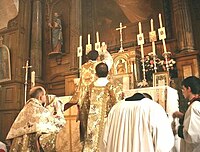
The following clarification of the celebration of Mass, usually in the local colloquial linguistic communication, is limited to the form of the Roman Rite promulgated at the request of the Second Vatican Quango (1962–65) past Pope Paul Half-dozen in 1969 and revised by Pope John Paul II in 2002, replacing the Tridentine Mass grade originally promulgated in 1570 in accordance with decrees of the Council of Trent in its closing session (1545–46).
The 1962 form of the Tridentine Mass, in the Latin language alone, may be employed where authorized by state of the vatican city or, in the circumstances indicated in the 16 July 2021 certificate Traditionis custodes,[17] by the diocesan bishop. In this grade the priest usually (though not obligatorily) faces the people (versus populum); in the earlier form the priest most often faces in the aforementioned management as the people, towards the alcove of the church, a stance that since the twentieth century is oft called ad orientem, although not necessarily due east.
As mentioned, the Eucharistic liturgy is celebrated in the Catholic Church also in other Latin liturgical rites and in those of the Eastern Catholic Churches.
The Canon of the Catholic Church discusses the importance of the Mass in the Catholic tradition under the headings:
- I. The Eucharist - Source and Summit of Ecclesial Life
- II. What is This Sacrament Chosen?
- III. The Eucharist in the Economy of Salvation
- IV. The Liturgical Commemoration of the Eucharist
- V. The Sacramental Sacrifice Thanksgiving, Memorial, Presence
- VI. The Paschal Banquet
- VII. The Eucharist - "Pledge of the Glory To Come"[18]
Liturgical books [edit]
The Roman Missal contains the prayers, antiphons and rubrics of the Mass.
The Lectionary presents passages from the Bible arranged in the lodge for reading at each day'south Mass. Compared with the scripture readings in the pre-Vatican Ii Missal, the modern Lectionary contains a much wider variety of passages, too extensive to include in the Missal. A split up Book of the Gospels, also chosen the Evangeliary,[19] is recommended for the reading from the Gospels, only where this book is not available the Lectionary, which also includes the Gospels, is used.
The well-nigh oftentimes historic grade of the Roman-Rite Mass is that in the mail-Vatican 2 editions of the Roman Missal. Authorization for use of the earlier (1962) form may be granted by the holy see or, as indicated in the 2021 document Traditionis custodes,[20] by the diocesan bishop.
Liturgical structure [edit]
The Eucharistic celebration is "one unmarried act of worship" but consists of unlike elements, which always include "the proclamation of the Discussion of God; thanksgiving to God the Male parent for all his benefits, to a higher place all the gift of his Son; the induction of bread and wine, which signifies besides our ain transformation into the trunk of Christ;[21] and participation in the liturgical feast by receiving the Lord's body and blood".[22]
Within the fixed structure of the Roman-Rite Mass outlined beneath, the "proper" or daily-varying parts are the Scripture readings and responsorial psalm, the antiphons at the archway and communion processions, and the texts of the three prayers known as the collect, the prayer over the gifts, and the prayer after communion. These convey themes from the liturgical flavor, the feast days of titles or events in the life of Christ, the feast days and commemorations of the saints, or for Masses for particular circumstances (east.thou., funeral Masses, Masses for the celebration of Confirmation, Masses for peace, to begin the academic year, etc.).
Introit, procession, and introductory rites [edit]
The priest enters in procession into the nave with altar servers, and with a deacon if in that location is one. The deacon may conduct the Evangelion (Gospel volume), which he will identify on the altar; and one altar server, called the crucifer, carries a processional cross at the front of the procession. Other servers may carry blessed candles, incense and a thurible. During this procession, ordinarily, the archway chant or hymn is sung.[23] If there is no singing at the archway, the entrance antiphon is recited either by some or all of the faithful or by a lector; otherwise it is said by the priest himself.[24] When the procession arrives at the sanctuary, all bow toward the altar. The priest and other ordained ministers kiss the altar. So, when the priest arrives at his chair, he leads the assembly in making the Sign of the Cross, saying: "In the proper name of the Male parent, and of the Son, and of the Holy Spirit,"[25] [26] to which the faithful answer: "Amen." Then the priest "signifies the presence of the Lord to the customs gathered there by ways of the Greeting. By this Greeting and the response of the true-blue, the mystery of the Church gathered together is fabricated manifest."[27] The greetings are derived from the Pauline epistles.

Then the priest invites those present to take part in the Penitential Act, of which the Missal proposes 3 forms, the first of which is the Confiteor. 1 form includes tropes acclaiming God's deeds on our behalf, and the priest has some freedom in formulating these. This is ended with the priest's prayer of absolution, "which, however, lacks the efficacy of the Sacrament of Penance."[28] It does absolve venial sins, all the same. "From time to time on Sundays, especially in Easter Time, instead of the customary Penitential Act, the blessing and sprinkling of h2o may accept place as a reminder of Baptism."[28] This anniversary, in which the congregation is cleansed with holy water, is known equally the Asperges.
"After the Penitential Act, the Kyrie, Eleison (Lord, have mercy) is ever begun, unless information technology has already been part of the Penitential Act. Since it is a chant by which the faithful acclaim the Lord and implore his mercy, it is ordinarily executed by everyone, that is to say, with the true-blue and the choir or cantor taking function in information technology."[29] The Kyrie may be sung or recited in the vernacular language or in the original Greek.[30] It is the only portion of the Mass in Greek instead of Latin or Latinised Hebrew.
"The Gloria in Excelsis (Celebrity to God in the highest) is a nearly ancient and venerable hymn by which the Church, gathered in the Holy Spirit, glorifies and entreats God the Male parent and the Lamb. ...It is sung or said on Sundays outside Advent and Lent, and also on Solemnities and Feasts, and at particular celebrations of a more solemn graphic symbol."[31] The Gloria is omitted at requiem Masses (funerals and Masses for the dead) on ordinary banquet-days of saints, weekdays, and Votive Masses. It is also optional, in line with the perceived caste of solemnity of the occasion, at Ritual Masses such as those historic for Matrimony ("Nuptial Mass"), Confirmation or Religious Profession, at Masses on the Ceremony of Marriage or Religious Profession, and at Masses for Diverse Needs and Occasions.
"Adjacent the Priest calls upon the people to pray and everybody, together with the Priest, observes a brief silence and then that they may become enlightened of beingness in God's presence and may call to mind their intentions. Then the Priest pronounces the prayer commonly called the "Collect" and through which the character of the celebration finds expression."[32]
Liturgy of the Discussion [edit]
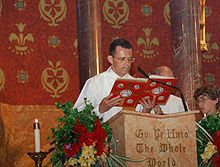
On Sundays and solemnities, three Scripture readings are given. On other days there are simply ii. If there are three readings, the start is from the Old Testament (a term wider than Hebrew Scriptures, since it includes the Deuterocanonical Books), or the Acts of the Apostles during Eastertide. The first reading is followed by a Responsorial Psalm, a complete Psalm or a sizeable portion of one. A cantor, choir or lector leads, and the congregation sings or recites a refrain. "That the people may be able to sing the Psalm response more readily, texts of some responses and Psalms have been chosen for the various seasons of the year or for the diverse categories of Saints. These may exist used in place of the text corresponding to the reading whenever the Psalm is sung."[33] The 2nd reading is from the New Testament, typically from ane of the Pauline epistles. The reader begins virtually reading with the introductory statement "a reading from the Volume of..." or "a reading from the Alphabetic character to...," and concludes each reading past proclaiming that the reading is "the word of the Lord,"; the congregation responds past proverb "Thank you be to God." The lector will usually be a scheduled volunteer from among the congregation; when 2 non-Gospel readings are given, they may be given by 2 dissimilar lectors or past one, according to local preference.
The final reading and high point of the Liturgy of the Give-and-take is the proclamation of the Gospel. This is preceded past the singing of the Gospel Acclamation, typically an Alleluia with a poesy of Scripture, which may be omitted if not sung. Alleluia is replaced during Lent past a different acclamation of praise. All stand while the Gospel is chanted or read by a deacon or, if none is available, by a priest. The reading is traditionally introduced with the phrase "a reading from the Holy Gospel according to" followed by the evangelist's name. To conclude the Gospel reading, the priest or deacon proclaims: "The Gospel of the Lord" and the faithful respond, "Praise to you, Lord Jesus Christ." The priest or deacon then kisses the book.[34] If a deacon participates, he reads the Gospel. If a deacon is not nowadays, the jubilant priest or a concelebrant, if at that place is one, proclaims it.[35]
At least on Sundays and Holy Days of Obligation, a homily, a sermon that draws upon some aspect of the readings or of the liturgy, is and so given. Commonly the priest celebrant himself gives the homily, simply he may entrust information technology to a concelebrating priest or to the deacon, but never to a lay person. In item cases and for a just cause, a bishop or priest who is present but cannot concelebrate may give the homily. On days other than Sundays and Holy Days of Obligation, the homily, though not obligatory, is recommended.[36]
On Sundays and solemnities, all then profess their Christian religion by reciting or singing the Nicene Creed or, especially from Easter to Pentecost, the Apostles' Creed, which is particularly associated with baptism and is often used in Masses for children.
The Liturgy of the Discussion concludes with the Universal Prayer or Prayer of the Faithful. The priest begins it with a brief introduction, then a deacon, a cantor, or another lay person announces some intentions for prayer, to which the congregation responds with a brusk invocation such every bit "Lord hear our prayer." The priest concludes with a longer prayer.
Liturgy of the Eucharist [edit]
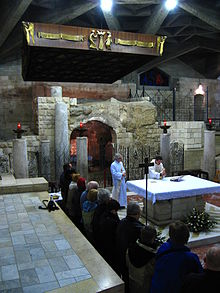
The linen corporal is spread over the center of the chantry, and the Liturgy of the Eucharist begins with the formalism placing on it of bread and vino. These may be brought to the altar in a procession, peculiarly if Mass is historic with a large congregation.[37] The unleavened, wheat staff of life (in the tradition of the Latin Church)[38] is placed on a paten, and the wine (from grapes) is put in a chalice and mixed with a little h2o, As the priest places each on the corporal, he says a silent prayer over each individually, which, if this rite is unaccompanied by singing, he is permitted to say aloud, in which instance the congregation responds to each prayer with: "Blessed be God forever." And so the priest washes his easily, "a rite in which the desire for interior purification finds expression."[39]
The congregation, which has been seated during this preparatory rite, rises, and the priest gives an exhortation to pray: "Pray, brethren, that my cede and yours may exist adequate to God, the almighty Father." The congregation responds: "May the Lord accept the sacrifice at your hands, for the praise and glory of his proper noun, for our skilful, and the good of all his holy Church building." The priest so pronounces the variable prayer over the gifts.
The Eucharistic Prayer, "the centre and high point of the entire commemoration",[40] and then begins with a dialogue between priest and the faithful. This dialogue opens with the normal liturgical greeting, "The Lord be with you", but in view of the special solemnity of the rite now beginning, the priest and so exhorts the faithful: "Elevator upwards your hearts." The faithful answer with: "We lift them up to the Lord." The priest and then introduces the great theme of "Eucharist", a give-and-take originating in the Greek word for giving thanks: "Let u.s.a. give cheers to the Lord, our God." The faithful join in this sentiment, saying: "It is right and merely."
The priest continues with 1 of many thematic Eucharistic Prayer prefaces, which lead to the Sanctus acclamation: "Holy, Holy, Holy Lord God of hosts. Heaven and earth are total of your glory. Hosanna in the highest. Blessed is he who comes in the name of the Lord. Hosanna in the highest."[41]
In some countries, including the United States, the faithful kneel immediately afterward the singing or recitation of the Sanctus. If a person is unable to kneel, he makes a profound bow after the Consecration[42] – the Institution Narrative that recalls Jesus' words and actions at his Concluding Supper: "Take this, all of yous, and eat of information technology: for this is my body which will exist given up for you. ...Accept this, all of you, and drink from it: for this is the chalice of my blood, the blood of the new and eternal covenant, which volition be poured out for you lot and for many for the forgiveness of sins. Do this in memory of me."[43] In many places, a consecrated bell is rung subsequently the acme of each element. The tradition of raising the host and chalice high after the Induction has its origin in the ad orientem celebration of the Mass, and is washed so that the people may more readily meet the Host. It is as well customary on solemnities and other days for the altar servers to offer incense to the Host and beaker during the meridian. The priest then announces: "The mystery of faith," and the true-blue answer with an acclaim, using one of 3 prescribed formulae.[44]
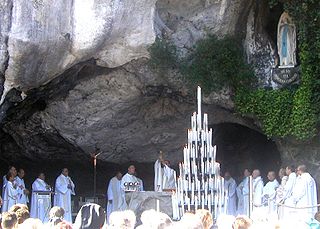
Mass at the Grotto at Lourdes. The chalice is displayed to the faithful immediately after the consecration of the wine.
The Eucharistic Prayer includes the Epiclesis (which since early Christian times the Eastern churches have seen as the climax of the Induction), praying that the Holy Spirit might transform the elements of bread and wine and thereby the people into one body in Christ.[45] The whole portion of the Retort recalling Christ's passion, death, and resurrection, is called the Anamnesis.
Intercessions for both the living and the souls in Purgatory follow. When there are priests concelebrating the Mass they join the primary celebrant in the central prayers, up to the intercessions, which they may divide amidst themselves.
The Retort ends with an emphatic doxology for which the priest elevates the paten with the Host and the deacon (if there is one) elevates the beaker, and the priest(southward) proclaim of Christ that "through him, with him, in him, in the unity of the Holy spirit, all glory and award is yours, Almighty Father, for ever and e'er," to which the faithful sing or chant the swell Amen. This Amen is the faithful's assent to all that God has wrought through the consecration and re-presention of the sacrifice of Christ.
Both the doxology and Great Amen are preferably sung or chanted. This is in line with the Instruction on Music in the Liturgy which says: "I cannot find anything more religious and more than joyful in sacred celebrations than a whole congregation expressing its faith and devotion in song. Therefore the active participation of the whole people, which is shown in singing, is to exist carefully promoted. ...It should beginning of all include acclamations, responses to the greetings of the priest and ministers and to the prayers of litany form, and also antiphons and psalms, refrains or repeated responses, hymns and canticles."[46]
Communion rite [edit]
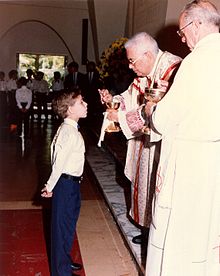
Reception of Holy Communion
The communion rite begins with a number of preparatory rites, of which the singing or recitation of the Our Male parent is the first. In the context of this preparation, the petitions for the daily bread and the forgiveness of trespasses proceeds particular significance. After an invitation by priest to practise so, priest and people together recite the Lord's Prayer. The priest adds to it a development of the final petition, known as the embolism: "Deliver us, Lord, nosotros pray, from every evil, graciously grant peace in our days, that, by the assistance of your mercy, we may be always gratuitous from sin and safe from all distress, every bit we await the blessed promise and the coming of our Savior, Jesus Christ." The true-blue then recite the doxology, "For the kingdom, the power, and the glory are yours, now and forever".[47]
During the joint recitation of the Lord's Prayer the priest is exceptionally directed to extend his hands in the orans position. In the liturgy, the priest ordinarily adopts this posture only when praying aloud and lonely while the congregation is silent. Other prayers said by the priest with the people, like the Holy, Holy in every Mass, are said with joined hands. This exception was introduced by Pope Pius XII, who just in the context of his Holy Week liturgical reforms permitted the congregation to join the priest in praying the Pater noster, provided that they could pray information technology in Latin.[48] [49] [fifty] In some locations members of the congregation accept either adopted the orans posture like the priest[51] or have held each other'southward easily. The United States bishops conference states: "No position is prescribed in the Roman Missal for an assembly gesture during the Lord's Prayer." Some recognized experts on the rubrics of the Roman Rite, the liturgists Edward McNamara and Peter Elliott, deplore the adoption of either of these postures by the congregation as a body,[52] [53] and both are subject to controversy.[54] [55] [56] [57] [58] [59]

The Rite of Peace, the pax, is the 2d preparatory rite for reception of Holy Communion. After praying: "Lord Jesus Christ, who said to your Apostles: Peace I get out you lot, my peace I requite you;[60] wait non on our sins, just on the faith of your Church, and graciously grant her peace and unity in accord with your will. Who live and reign for ever and ever," the priest wishes the faithful the peace of Christ: "The peace of the Lord be with you always." The deacon or, in his absenteeism, the priest may then invite those present to offering each other the sign of peace. The form of the sign of peace varies according to local custom for a respectful greeting (for case, a handshake or a bow between strangers, or a osculation/hug between family members).
The third preparatory rite is that of fraction and commingling. The priest breaks the host and places a piece in the chief chalice; this is of import every bit it symbolizes that the Body and Blood of Christ are both present within one another. Meanwhile, the "Lamb of God" ("Agnus Dei" in Latin) is sung or recited.[61]
The priest so presents the Eucharistic Breadstuff to the congregation, saying: "Behold the Lamb of God, behold him who takes away the sins of the world. Blessed are those who are chosen to the supper of the Lamb."[62] And so all repeat: "Lord, I am not worthy that you should enter under my roof, but only say the give-and-take and my soul shall be healed,"[63] which is a reference in the Gospel of Matthew to where a Roman centurion manifests exemplary faith in Jesus to heal his retainer, proverb that Jesus' word lonely was sufficient. The priest and then receives Communion. Post-obit this, if extraordinary ministers of Holy Communion are required, they may come forwards at this time, and approach the priest, presenting themselves for Communion. [64] With the help of the deacon and concelebrants and, if necessary, extraordinary ministers of Holy Communion, the priest then distributes Communion to the faithful.[65]
Co-ordinate to the Cosmic Church doctrine receiving the Holy Communion in a state of mortal sin is a sacrilege[66] and only those who are in a state of grace, that is, without any mortal sin, can receive information technology.[67] Based on 1 Corinthians 11:27-29 it affirms the following: "Anyone who is aware of having committed a mortal sin must not receive Holy Communion, even if he experiences deep contrition, without having first received sacramental absolution, unless he has a grave reason for receiving Communion and there is no possibility of going to confession."[68] [69] [seventy]
The faithful receive Communion kneeling or standing, every bit decided past the Episcopal Conference.[71] For instance, the United States Episcopal Conference has decreed that "Holy Communion is to be received standing, though private members of the true-blue may choose to receive Communion while kneeling",[72] while that for England and Wales says: "In the dioceses of England and Wales Holy Communion is to exist received standing, though individual members of the true-blue may choose to receive Communion while kneeling. However, when they communicate standing, information technology is recommended that the true-blue bow in reverence earlier receiving the Sacrament.[73]
The distributing minister says "The Torso of Christ" or "The Blood of Christ",[74] or "The Body and Blood of Christ" if both are distributed together (by intinction).[75] The communicant responds: "Amen." In most countries the communicant may receive the consecrated Host either on the tongue or in the hand, at the communicant's own discretion. If in the hand they should step aside and reverently swallow the Host immediately.[76]
While Communion is distributed, singing of an appropriate approved chant or hymn is recommended, to emphasize the substantially "communitarian" nature of the body of Christ.[77] If there is no singing, a short antiphon may exist recited either past the congregation or past some of them or past a lector. Otherwise, the priest himself recites it just earlier distributing Communion.[78]
"The sacred vessels are purified by the priest, the deacon, or an instituted acolyte subsequently Communion or afterwards Mass, insofar as possible at the credence table."[79] Then the priest concludes the Liturgy of the Eucharist with the Prayer afterwards Communion, for which the true-blue are invited to stand.
Concluding rite [edit]
After the Prayer subsequently Communion, announcements may be made. The Missal says these should be brief. The priest then gives the usual liturgical greeting and imparts his blessing. The liturgy concludes with a dialogue between the priest and the associates. The deacon, or in his absence, the priest himself then dismisses the faithful. The 2011 edition of the Missal adds new versions of the dismissal.[80] [81]
The faithful respond: "Thanks exist to God." The priest and other ministers then venerate the chantry with a kiss, form a procession, and get out the sanctuary, preferably to a recessional hymn or chant from the Graduale, sung by all.
The Mass being over, the faithful may depart or stay a while, pray, light votive candles at shrines in the church, converse with one another, etc. In some countries, including the United States, the priest customarily stands exterior the church door to greet the true-blue individually every bit they go out.
Time of celebration of Mass [edit]
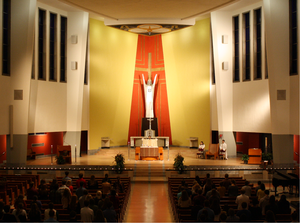

Except during the Paschal Triduum no limits are laid down for the time of celebrating Mass. The traditional rule included in the 1917 Code of Canon Law, forbidding (except to a limited extent on Christmas Night) celebration before than one hour before dawn or subsequently than ane hr subsequently midday,[82] was relaxed in the liturgical reforms of Pope Pius XII and completely abolished in those of the Second Vatican Council.
Since the Second Vatican Council, the fourth dimension for fulfilling the obligation to nourish Mass on Sunday or a Holy Day of Obligation now begins on the evening of the day before,[83] [84] and about parish churches do gloat the Dominicus Mass also on Sat evening. By long tradition and liturgical law, Mass is not celebrated at any fourth dimension on Practiced Friday, but rather the Celebration of the Passion of the Lord (with hosts consecrated at the Mass of the Lord's Supper on Holy Thursday). Nor may Mass on Holy Sabbatum be celebrated before the Easter Vigil (the start of the celebration of Easter Dominicus, which is customarily begun only after sunset, completing the Easter Triduum which began on Thursday).
Priests are required to celebrate Mass oft and are earnestly recommended to do and so daily.[85] However, "apart from those cases in which the law allows him to celebrate or concelebrate the Eucharist a number of times on the same 24-hour interval, a priest may non celebrate more than than once a solar day,"[85] and "a priest may non celebrate the Eucharistic Cede without the participation of at least one of the true-blue, unless in that location is a good and reasonable crusade for doing so."[85]
Priests are required by their posts to celebrate Mass at to the lowest degree on Sundays, for the faithful in their pastoral intendance. The bishop of a diocese[86] and the pastor of a parish[87] are required to celebrate or adjust for another priest to gloat on every Lord's day or Holy Day of Obligation, a Mass "pro populo" – that is, for the faithful entrusted to his care.
For Latin Rite priests, there are a few general exceptions to the limitation to celebrate just i Mass a day.[88] By tradition, they may gloat Mass three times on Christmas Day (the Midnight Mass or "Mass of the Angels", the Dawn Mass or "Shepherd'south Mass", and the Day Mass or "Mass of the Divine Word", each of which has its ain readings and chants).
On All Souls' Day they may as well, on the basis of a privilege to all priests by Pope Bridegroom XV in Baronial 1915, celebrate Mass three times; only i of the iii Masses may be for the personal intentions of the priest, while the other two Masses must be for all the faithful departed and for the intentions of the Pope. A priest who has concelebrated the Chrism Mass, which may be held on the morning of Holy Thursday, may also celebrate or concelebrate the Mass of the Lord'due south Supper that evening. A priest may gloat or concelebrate both the Mass of the Easter Vigil and Mass of Easter Sunday (the Easter Vigil "should non begin before nightfall; it should end before daybreak on Sunday"; and may therefore take place at midnight or in the early hours of Easter morning time). Finally, a priest who has concelebrated Mass at a meeting of priests or during a pastoral visitation past a bishop or a bishop'due south delegate, may celebrate a second Mass for the benefit of the laity.
In improver to these general permissions, the Local Ordinary may, for a good reason, allow priests to celebrate twice (they are and so said to "binate") on weekdays, and three times ("trinate" or "trination") on Sundays and Holy Days (catechism 905 §2). Examples would be if a parish priest were to demand to celebrate the usual, scheduled daily Mass of a parish and a funeral later in the morning, or iii Masses to accommodate all of the parishioners in a very populous parish on Sundays. In specially hard circumstances, the Pope can grant the diocesan bishop permission to give his priests faculties to trinate on weekdays and quadrinate on Sundays.
In many countries, the bishop's power to permit priests to gloat two or iii Masses on one day is widely used, and it is common for priests assigned to parish ministry to celebrate at least two Masses on whatever given Lord's day, and two Masses on several other days of the week. Permission for four Masses on one day has been obtained in club to cope with large numbers of Catholics either in mission lands or where the ranks of priests are diminishing. This sometimes also happens in the instance of celebrated churches which are unusually small compared to their number of parishioners, simply which have not been replaced due to their historic character.
Summary table regarding priests with pastoral responsibilities [edit]
| Situation | Masses permitted | Masses required* |
|---|---|---|
| Normal weekday | 1 | 0 |
| Normal Lord's day | 1 | 1 |
| Lord's day, for but reasons** | 2 | 1 |
| All Souls' Twenty-four hour period | iii | one |
| Christmas Twenty-four hour period*** | 3 | 1 |
| Weekday with permission of Local Ordinary | 2 | 0 |
| Dominicus or Holy Day with permission of Local Ordinary | three | ane |
| Weekday with permission of the Pope through Local Ordinary | 3 | 0 |
| Sunday or Holy Twenty-four hours with permission of the Pope through Local Ordinary | 4 | 1 |
* By any priest of a parish for the people; that is to say, private priests are not required to say Masses on these days per se, but a Mass in each parish or oratory must be available for the people.
** According to the pastor's own judgment.
*** By longstanding custom, this includes the First Mass of Christmas "during the dark", even if it begins somewhat before than midnight.
Duration of the commemoration [edit]
The length of time that it takes to celebrate Mass varies considerably. While the Roman Rite liturgy is shorter than other liturgical rites, it may on solemn occasions – even autonomously from exceptional circumstances such as the Easter Vigil or an event such as ordinations – have over an hour and a one-half. The length of the homily is an obvious cistron that contributes to the overall length. Other factors are the number of people receiving Communion and the number and length of the chants and other singing.
For virtually of the second millennium, before the twentieth century brought changes starting time with Pope Pius X's encouragement of frequent Communion, the usual Mass was said exactly the same mode whether people other than a server were present or not. No homily was given,[89] and nearly often only the priest himself received Communion.[90] Moral theologians gave their opinions on how much fourth dimension the priest should dedicate to celebrating a Mass, a matter on which canon law and the Roman Missal were silent. One said that an hour should non be considered too long. Several others that, in order to avoid tedium, Mass should last no more than than half an hour; and in society to be said with due reverence, information technology should concluding no less than twenty minutes. Another theologian, who gave half an 60 minutes as the minimum time, considered that Mass could not be said in less than a quarter of an hour, an opinion supported by others, including Saint Alphonsus Liguori who said that any priest who finished Mass in less than that time could scarcely be excused from mortal sin.[91]
Ritual Masses [edit]
A Mass celebrated in connexion with a particular rite, such as an ordination, a wedding, or a profession of religious vows, may use texts provided in the "Ritual Masses" section of the Roman Missal. The rite in question is, about frequently, a sacrament, simply the section has special texts non simply for Masses inside which Baptism, Confirmation, Anointing of the Sick, Holy orders, and Matrimony are celebrated, but as well for Masses with religious profession, the dedication of a church, and several other rites. Penance is the but sacrament non celebrated within a Eucharistic framework and for which therefore no Ritual Mass is provided.[ citation needed ]
The Ritual Mass texts may non be used, except perhaps partially, when the rite is historic during specially important liturgical seasons or on high ranking feasts.
A Nuptial Mass[92] is a Ritual Mass within which the sacrament of matrimony is celebrated. If one of a couple being married in a Catholic church is not a Cosmic, the rite of wedlock outside Mass is to be followed. Still, if the non-Catholic has been validly baptized, then, in exceptional cases and provided the bishop of the diocese gives permission, it may be considered suitable to celebrate the spousal relationship within Mass, except that, co-ordinate to the general law, Communion is not given to the non-Cosmic (Rite of Marriage, 8). The Nuptial Mass contains special prayers for the couple and, in the ordinary form of the Roman Rite, may exist offered at any time of the liturgical year, except during the Paschal Triduum.[93]
See as well [edit]
- Mass (liturgy)
- Mass (music)
References [edit]
- ^ Schrader, Fr. Dylan. The Society of Mass (The Extraordinary Class of the Roman Rite) (PDF). Ipsissima Verba. pp. 1, eighteen.
- ^ Basalyga, Benjamin (1948). "The Divine Liturgy History: Lodge OF THE LITURGY". www.athanasius.com . Retrieved 2021-02-xiii .
{{cite web}}: CS1 maint: url-status (link) - ^ [1] John Hardon, Mod Catholic Dictionary
- ^ "Catechism of the Catholic Church building - The sacrament of the Eucharist". www.vatican.va . Retrieved 2018-08-20 .
- ^ "CCC, 'The Paschal Mystery'". Vatican.va. Archived from the original on 16 June 2012. Retrieved 26 June 2012.
- ^ Hovhanessian, Vahan (2011). "Badarak (Patarag)". The Encyclopedia of Christian Civilisation. doi:10.1002/9780470670606.wbecc0112. ISBN9781405157629.
- ^ "Extraordinary Form of the Mass | USCCB". world wide web.usccb.org . Retrieved 2020-09-18 .
- ^ "Letter to the Bishops that accompanied the Apostolic Letter "Motu Proprio data" Summorum Pontificum on the Roman liturgy prior to the reform of 1970 (July 7, 2007) | Bridegroom 16". world wide web.vatican.va.
- ^ Traditionis custodes, commodity 1
- ^ Herbermann, Charles, ed. (1913). . Catholic Encyclopedia. New York: Robert Appleton Company.
- ^ "Sacramentum Caritatis: Post-Synodal Apostolic Exhortation on the Eucharist as the Source and Peak of the Church'southward Life and Mission (22 February 2007) | Benedict Xvi". www.vatican.va . Retrieved 2018-08-20 .
- ^ a b Moorman, Msgr. George (2010). The Latin Mass Explained. Charlotte, NC: TAN Books. pp. fifteen–30. ISBN9780895557643.
- ^ "Now Online! Fr. Josef Jungmann's Report of the Roman Rite "Missarum Sollemnia"". Corpus Christi Watershed. 2014-01-25. Retrieved 2020-09-11 .
- ^ The Eucharistic Liturgies: Their Evolution and Interpretation. Liturgical Press; 2012. ISBN 978-0-8146-6240-3. pp=1–59.
- ^ Bradshaw and Johnson (2012), pp. 70–71
- ^ Adrian Fortescue. The Mass: A Study of the Roman Liturgy. Longmans Dark-green & Co; 1917. ISBN 978-5-87294-812-4. p. 177–180.
- ^ Traditionis custodes
- ^ "Canon of the Catholic Church building". world wide web.vatican.va.
- ^ General Teaching of the Roman Missal (GIRM), paragraph 44
- ^ Traditionis custodes, commodity 2
- ^ 1 Corinthians 10:17
- ^ "Canon of the Cosmic Church - IntraText". world wide web.vatican.va . Retrieved 2017-04-29 .
- ^ "The antiphon with its Psalm from the Graduale Romanum or the Graduale Simplex, or another chant ... whose text has been approved by the Conference of Bishops". GIRM, paragraph 48
- ^ GIRM, paragraph 256
- ^ "THE ORDER OF MASS" (PDF). International Commission on English in the Liturgy, Inc. 2010. Retrieved November 19, 2011.
- ^ "The Holy Mass". Retrieved November 19, 2011.
- ^ GIRM, paragraph 50
- ^ a b GIRM, paragraph 51
- ^ GIRM, paragraph 52
- ^ Roman Missal, "The Lodge of Mass", seven
- ^ GIRM, paragraph 53
- ^ GIRM, paragraph 54
- ^ GIRM, paragraph 61
- ^ Roman Missal, "The Lodge of Mass", sixteen
- ^ Roman Missal, "The Order of Mass", 14
- ^ GIRM, paragraph 66
- ^ "Information technology is a praiseworthy practice for the bread and wine to be presented by the faithful." GIRM, paragraph 73
- ^ GIRM, paragraph 320
- ^ GIRM, paragraph 76
- ^ GIRM, paragraph 78
- ^ Sanctus from Missa de Angelis [twelfth century] (vimeo) (in Latin). València. Retrieved twenty April 2018.
- ^ "The true-blue [...] should kneel [...] at the Consecration, except when prevented on occasion by ill health, or for reasons of lack of infinite, of the big number of people nowadays, or for another reasonable crusade. Nonetheless, those who do non kneel ought to brand a profound bow when the Priest genuflects after the Consecration." GIRM, paragraph 43
- ^ Luke 22:xix; one Corinthians 11:24–25
- ^ GIRM, paragraph 151
- ^ GIRM, paragraph 79c,f
- ^ "Musicam sacram". www.vatican.va. 16. Retrieved 2017-04-30 .
- ^ GIRM, paragraphs 80–81
- ^ "Liturgy & Sacraments Documentation". www.canonlaw.info.
- ^ "'Orans' posture during Our Begetter". www.thebostonpilot.com.
- ^ Bob Sullivan, "How should we pray the Our Father?" in Southern Nebraska Annals, 26 Jan 2018
- ^ "Mass at Lourdes" (PDF).
- ^ "Holding Hands at the Our Begetter? | EWTN". EWTN Global Cosmic Idiot box Network.
- ^ Peter J. Elliott. Liturgical Question Box: Answers to Common Questions near the Modern Liturgy. Ignatius Press; 1 Jan 1998. ISBN 978-ane-68149-302-2. p. 74.
- ^ Philippart, David (2011-10-22). "Why do nosotros hold hands during the Our Father?". U.Southward. Cosmic magazine - Organized religion in Real Life . Retrieved 2020-09-16 .
- ^ "Un évêque décrète : on ne se tient pas la chief pendant le Notre Père. – Schola Saint Maur" (in French). 24 May 2013. Retrieved 2020-09-18 .
- ^ "Should we agree hands during the Lord'south prayer?". U.Due south. Catholic mag - Faith in Real Life. 2014-03-20. Retrieved 2020-09-sixteen .
- ^ "Should we hold easily or not during the Our Father?". National Catholic Reporter. 2017-06-29. Retrieved 2020-09-16 .
- ^ "¿Está bien tomarnos de las manos al rezar el Padrenuestro en Misa?". Catholic.cyberspace (in Spanish). Retrieved 2020-09-18 .
- ^ "Michael Kerper, "Why does everyone do something different at Mass?" in Diocese of Manchester: The Cosmic Church in New Hampshire" (PDF).
- ^ John 14:27
- ^ GIRM, paragraph 83
- ^ [Rev xix:9]
- ^ Mat 8:eight
- ^ GIRM, paragraph 162
- ^ GIRM, paragraph 160
- ^ "Holy Communion". www.catholicity.com.
- ^ Compendium of the Canon of the Catholic Church # 291 . Retrieved xx August 2019.
- ^ Catechism of the Catholic Church building #1385 . Retrieved twenty August 2019.
- ^ Canon of the Catholic Church #1457 . Retrieved 20 Baronial 2019.
- ^ Code of Canon Police, canon 916 Archived June 28, 2011, at the Wayback Automobile
- ^ [Fideles communicant genuflexi vel stantes, prout Conferentia Episcoporum statuerit (Institutio Generalis Missalis Romani, 160
- ^ "General Education of the Roman Missal". world wide web.vatican.va.
- ^ "with adaptations for England and Wales" (PDF).
- ^ Mat 26:26-28
- ^ GIRM, paragraph 287
- ^ Jn vi:50-56
- ^ GIRM, paragraph 86
- ^ GIRM, paragraph 87
- ^ GIRM, paragraph 279
- ^ "The Mass | The Last Rites - Liturgy | Our Lady of Mount Carmel Wentworthville". sites.google.com . Retrieved 2017-04-30 .
- ^ "Holy Mass...concludes with the sending along (missio) of the faithful, so that they may fulfill God'due south will in their daily lives." - Catechism of the Catholic Church §1332
- ^ "CIC 1917: text - IntraText CT". world wide web.intratext.com.
- ^ "THE LITURGICAL Agenda AND THE LITURGY OF THE HOURS". Federation of Diocesan Liturgical Commissions. Archived from the original on October 28, 2011. Retrieved Nov xix, 2011.
- ^ Letter De Missa vespere sabbati of the Congregation of Rites dated Sept 25 1965, in Enchiridion Documentorum Instaurationis Liturgicae, vol I, northward. 35
- ^ a b c "Lawmaking of Canon Law - IntraText". world wide web.vatican.va . Retrieved 2017-04-30 .
- ^ "Code of Canon Police force - IntraText". world wide web.vatican.va . Retrieved 2017-04-30 .
- ^ "Code of Canon Constabulary - IntraText". world wide web.vatican.va . Retrieved 2017-04-30 .
- ^ GIRM, paragraph 204
- ^ Preaching was mostly washed outside Mass. The Ritus servandus in celebratione Missae Archived 2008-04-12 at the Wayback Automobile of the Tridentine Missal mentions preaching at Mass but in connection with Solemn Mass (in section Vi, 60) and but equally a possibility.
- ^ Ellard, Gerald. "Chapter XI: Sacrificial-Mindedness Largely Lost - and Found". CHRISTIAN LIFE AND WORSHIP. Archived from the original on September 28, 2011. Retrieved November 19, 2011.
- ^ Liguori, Alphonsus (1846). Jones, James (ed.). Sacerdos Sanctificatus; or, Discourses on the Mass and Office. pp. 30–33. Retrieved November xix, 2011.
- ^ Herbermann, Charles, ed. (1913). . Catholic Encyclopedia. New York: Robert Appleton Company.
- ^ "An Analysis of Diocesan Wedlock Preparation Policies". www.usccb.org . Retrieved 2020-02-27 .
Farther reading [edit]
- A biblical walk through the Mass : understanding what nosotros say and do in the liturgy. Rising Press. 2011. ISBN978-1-935940-00-5.
Source: https://en.wikipedia.org/wiki/Mass_in_the_Catholic_Church
0 Response to "Roman Catholic Readings for Mass for St. Patrick"
Post a Comment